Twenty questions
A good player does not ask "is it my grandmother's teapot?"; they ask "is it alive?": either answer rules out about half the possibilities.
- A tree plays the same game with data: each node asks feature ≤ threshold?
- Each answer sends the example down a branch; each leaf holds a prediction.
- Learning a tree is choosing the questions.
The path of this part
- Measure impuritytwenty questions; Gini and entropy
- Find the best splitevery feature, every midpoint, scored
- Grow and predictgreedy recursion; a leaf holds proportions
- Stop in timeoverfitting and pre-pruning
- Read the ruleseach path is a rule
12 customers, one question
| A | B | C | D | E | F | G | H | I | J | K | L | |
|---|---|---|---|---|---|---|---|---|---|---|---|---|
| tenure (months) | 2 | 3 | 5 | 6 | 8 | 11 | 14 | 19 | 24 | 30 | 38 | 50 |
| bill (R$) | 95 | 120 | 60 | 110 | 45 | 130 | 70 | 115 | 55 | 125 | 100 | 65 |
| churn | 1 | 1 | 0 | 1 | 0 | 1 | 0 | 0 | 0 | 1 | 0 | 0 |
Five of the 12 churned. Look for one question that separates the churners from the rest.
The parts of a tree
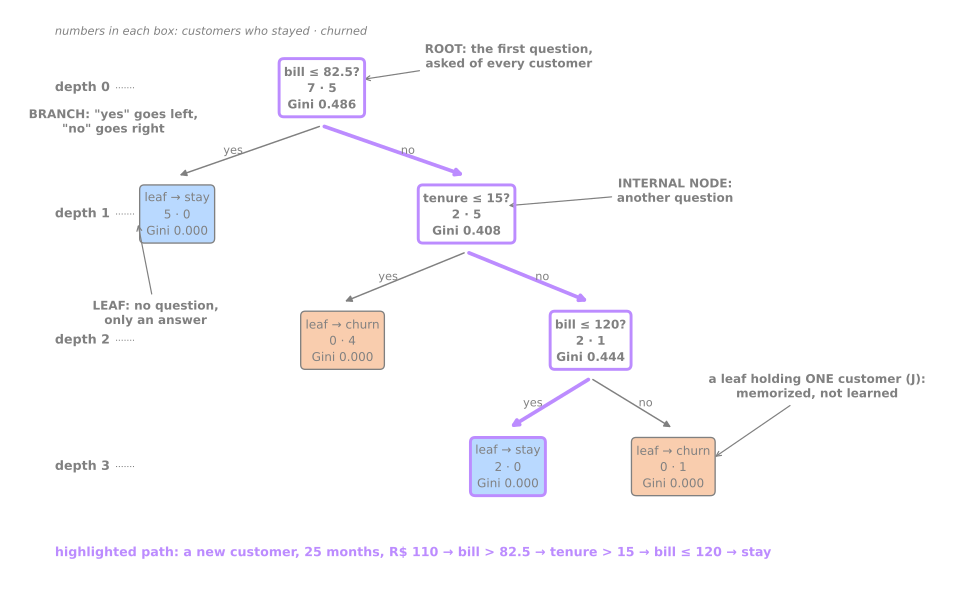
Impurity: how mixed is a node?
Gini (CART)
\[ G = 1 - \sum_c p_c^2 \]chance that two examples drawn at random have different classes
Entropy (ID3, C4.5)
\[ H = -\sum_c p_c \log_2 p_c \]bits needed to encode an example's class
Both are 0 at a pure node and largest at 50/50 (\(G = 0.5\), \(H = 1\)). At the root, 7 stayed and 5 churned:
\[ G = 1 - \left(\tfrac{7}{12}\right)^2 - \left(\tfrac{5}{12}\right)^2 = 0.486 \qquad H = 0.980 \]The best question: every split
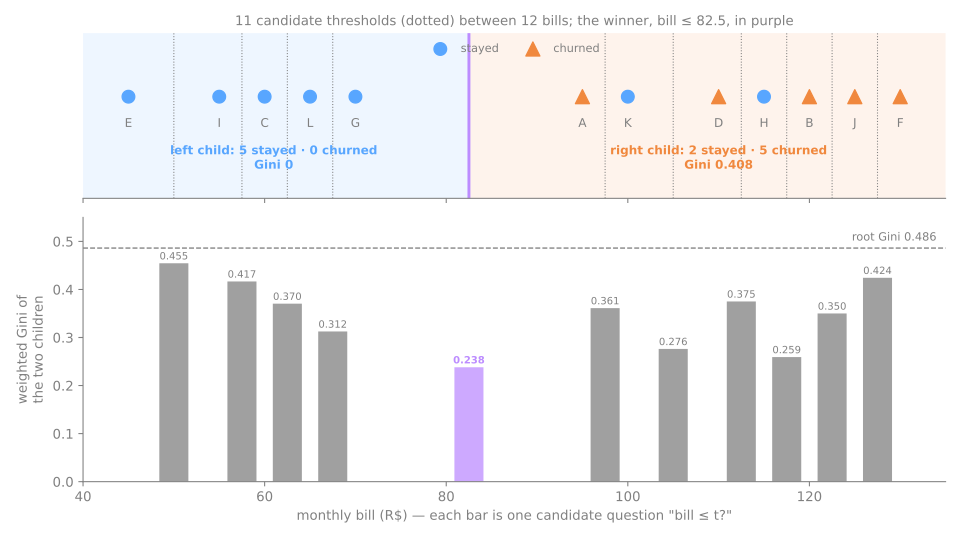
The winner, by hand: bill ≤ 82.5
- Left: 5 stayed, 0 churned → Gini 0.
- Right: 2 stayed, 5 churned → \(G_R = 1 - (2/7)^2 - (5/7)^2 = 0.408\).
- No other
billthreshold comes close; the best ontenure(≤ 4) scores 0.350. - Between two neighboring values every threshold gives the same split: CART only tries the midpoints.
DecisionTreeClassifier(max_depth=1) finds the same feature, the same threshold and the same three Gini values: 0.486, 0 and 0.408.Greedy and recursive
GROW(node):
  if the node is pure, at max depth
  or too small: make it a leaf
  for each feature j and
  each midpoint t:
    score x_j <= t by the decrease Δ
  apply the best split
  GROW(left); GROW(right)
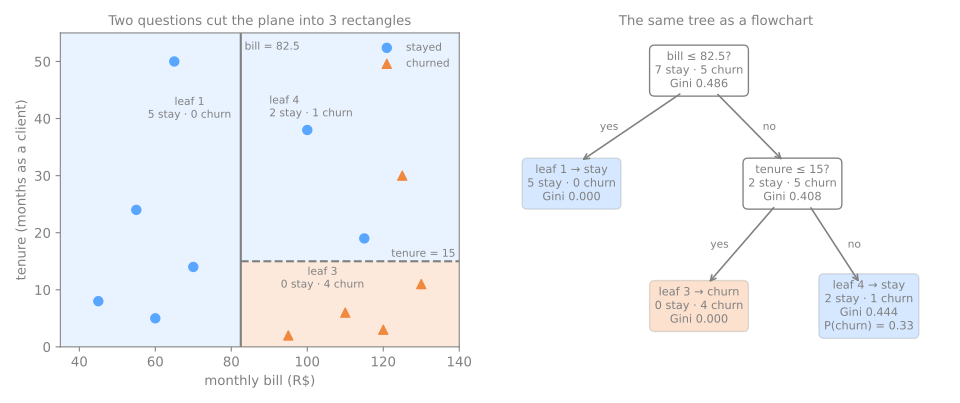
Predicting is following a path; the leaf holds proportions
| customer | tenure | bill | leaf | P(stay) | P(churn) |
|---|---|---|---|---|---|
| M | 6 | 70 | 5 stayed · 0 churned | 1.000 | 0.000 |
| N | 4 | 115 | 0 · 4 | 0.000 | 1.000 |
| O | 25 | 110 | 2 · 1 | 0.667 | 0.333 |
predict_proba returns the class proportions of the leaf's training examples. A tree with 3 leaves can only produce 3 distinct probabilities.Grown to purity
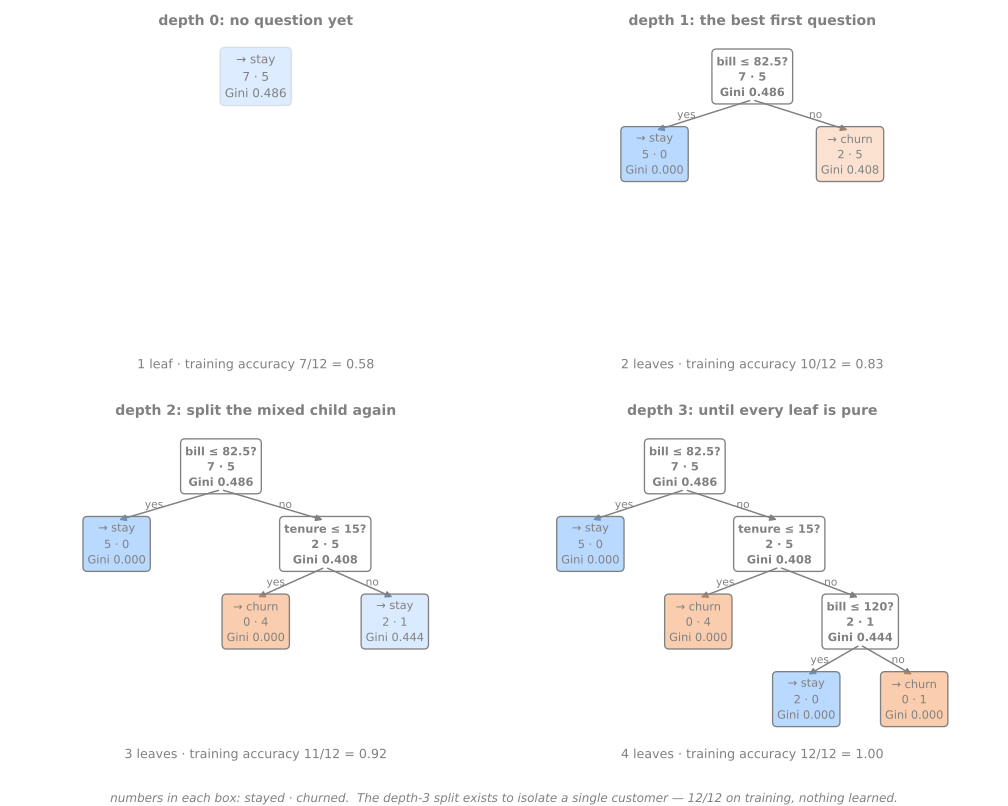
The third split exists because of one customer (J). 100% on training, nothing learned.
Simulator: growing a tree, one split at a time
Predict. Raise the depth from 0 to 8. Does the training impurity ever go up? What do the regions look like at depth 8?
On a real dataset: a fully grown tree memorizes
Spambase: 4,207 e-mails (without the 394 duplicated rows), 57 features.
| limit | train | validation | leaves |
|---|---|---|---|
| none (fully grown) | 1.000 | 0.906 | 181 |
max_depth=3 | 0.890 | 0.880 | 8 |
max_depth=10 | 0.967 | 0.915 | 86 |
min_samples_leaf=50 | 0.902 | 0.892 | 30 |
max_leaf_nodes=40 | 0.950 | 0.906 | 40 |
max_depth, min_samples_leaf, max_leaf_nodes. With 40 leaves, the same validation as the 181-leaf tree: the other 140 only memorized.A path is a rule
A depth-2 tree on Spambase (counts: not spam, spam):
$rare andremoverare → not spam (1,770 against 356)$rare, butremoveappears → spam (211 against 19)$frequent andhprare → spam (687 against 50)$frequent, buthpappears → not spam (57 against 5): the data come from Hewlett-Packard
Summary
- A tree asks feature ≤ threshold questions, one at a time; predicting is following a path.
- A good question leaves the children purer: weighted Gini or entropy.
- The best split comes from brute force: every feature, every midpoint.
- Growth is greedy and recursive.
- Without a stopping rule the tree memorizes; cross-validation chooses how hard to hold it back.
| symptom | what to do |
|---|---|
| training 1.000, validation well below | limit the depth or the leaf size |
| a small tree almost as good as the big one | keep the small one: it can be read |
A key for penguins, steps 1 to 5
- Palmer penguins: 344 birds, three species, bill and flipper measurements, body mass, sex and island.
- A field guide's dichotomous key is a decision tree written by hand: we will build one and read it.
- Notebook on Colab (in Portuguese): nothing to download. Save a copy to your Drive.
- At every step, answer the Predict before running.
- Simulations: the root, chosen by you (step 4) and a tree memorizes even random labels (step 5).
Pace: steps 1 to 3 in 8 min; step 4 and the first simulation in 12 min; step 5 and the second in 10 min.