The path of this part
- Fine-tune a thin sliceLoRA counted layer by layer; why low rank is enough
- Challenge the treeswhy trees lead on tables; TabPFN; a fair test
- Face the open problemsreliability, evaluation, alignment, efficiency, governance
LoRA: freeze \(W\), train \(B\) and \(A\)
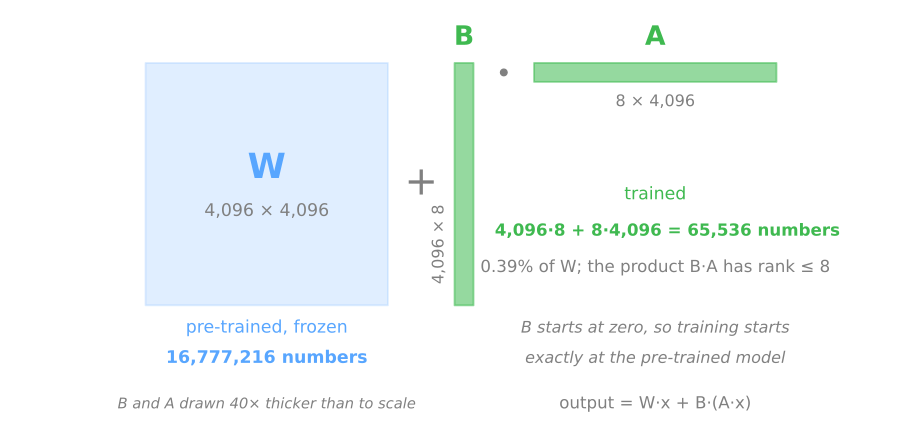
A layer computes \(h = Wx\): input \(x\), output \(h\), pre-trained weights \(W\) of \(d_{out} \times d_{in}\).
\[ h = Wx + B\,(Ax) \]\(B\): \(d_{out} \times r\) · \(A\): \(r \times d_{in}\) · rank \(r \ll d\)
trained: \(r\,(d_{in} + d_{out})\) instead of \(d_{in}\, d_{out}\)
LoRA, counted layer by layer
Predict. A model with the shape of Llama 2 7B. As the pieces add up (one matrix, a layer, 32 layers, the embeddings), does the share LoRA trains grow, shrink or stay the same? And the memory?
Why a thin slice can be enough
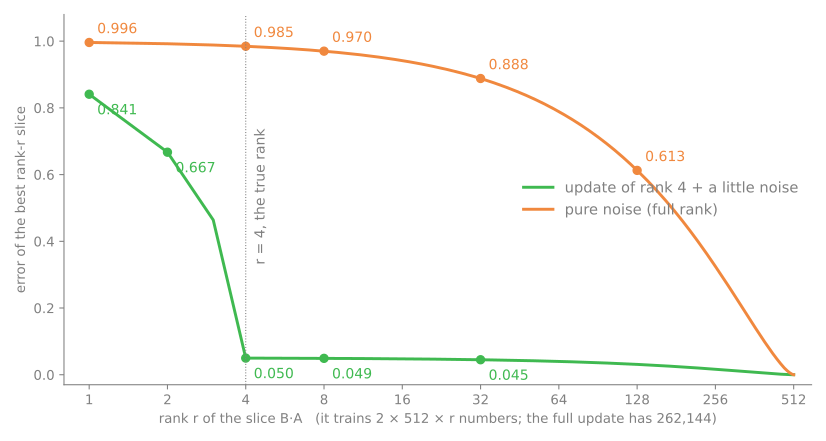
\(BA\) has rank at most \(r\): LoRA can only learn updates of rank \(\le r\). Predict: for an update of true rank 4, what happens to the error past \(r = 4\)? And for pure noise?
Why trees still lead on tables
Grinsztajn, Oyallon & Varoquaux (2022): 45 tabular datasets of around 10,000 rows, tree ensembles ahead of deep networks. Three reasons:
irregular targets
tables have jumps and thresholds; networks are biased toward smooth functions
useless columns
many uninformative columns hurt networks more than trees
columns mean something
a network's first layer mixes age with income; a tree asks about one column at a time
TabPFN: a forward pass instead of a fit
boosted trees
on your table: grow hundreds of trees, tune the hyperparameters with cross-validation, then predict
TabPFN (Hollmann et al., 2023, 2025)
a transformer pre-trained once on millions of synthetic tables. Input: your training rows and your new rows. Output: the predictions, in one forward pass
- PFN = prior-data fitted network (Müller et al., 2022): in-context learning, as in few-shot prompting, with a table in place of the prompt.
- Classification up to 10,000 rows: the 2025 version beat, in 2.8 seconds, an ensemble of the strongest baselines tuned for 4 hours.
- Larger tables, or tight latency: boosted trees remain the default.
Testing the challenger: who wins depends on the size
Predict. California housing samples: a regularized linear model against gradient boosting, same five folds. Who wins at 100 rows? At 10,000?
| rows | RMSE linear | RMSE boosting | boosting wins |
|---|---|---|---|
| 100 | 60,842 | 71,432 | 1 of 5 folds |
| 300 | 64,830 | 71,952 | 0 of 5 |
| 1,000 | 69,439 | 58,184 | 5 of 5 |
| 3,000 | 69,139 | 53,752 | 5 of 5 |
| 10,000 | 70,025 | 49,547 | 5 of 5 |
Open problems: where the field is going
- Hallucination and reliability: calibration at frontier scale; a model should know when it does not know.
- Evaluation: benchmarks saturate and leak into training data.
- Alignment and safety: RLHF (reinforcement learning from human feedback) and its successors are partial answers; a reward model learns the biases of its voters.
- Efficiency: distillation, quantization, small specialized models.
- Data provenance, bias and governance: the ethics questions, now regulated (EU AI Act; in Brazil the LGPD, the data protection law, and the AI bill PL 2338/2023).
- Causality: decisions need "what happens if we act".
- Agents: models that plan, call tools and act; evaluating them and keeping them safe is largely unsolved.
Summary
- LoRA trains \(r\,(d_{in} + d_{out})\) numbers per adapted matrix: 0.062% of a 7B model at \(r = 8\) on \(q\) and \(v\).
- It saves memory and storage: 107.8 GB → 13.5 GB to train; an 8.4 MB adapter per task. The frozen copy now dominates.
- It works because fine-tuning updates are close to low rank; a full-rank update does not fit a thin slice.
- TabPFN predicts a small table in one forward pass; boosted trees remain the default for large tables and tight latency.
- A challenger is tested like any model: your table, your size, the same folds.
Where to go from here
- Deep learning, in depth: the Insper course Artificial Neural Networks and Deep Learning; Prince, Understanding Deep Learning (2023, free online).
- The probabilistic view: Murphy, Probabilistic Machine Learning (2022, free online).
- LLMs, hands on: the Hugging Face courses; Karpathy's Neural Networks: Zero to Hero.
- Reading papers: pick a dashed chip on the map, read its classic paper, then a recent paper that cites it.
Count, compress and test, steps 5 to 7
- Same Colab notebook (or a new one): step 5 uses
totalandlorafrom the counting block of section 6; run it first. - Step 5: what fine-tuning costs in memory · step 6: when is a thin slice enough? · step 7: who wins depends on the size of the table.
- Simulations: shrink the frozen part (step 5, QLoRA in 4 bits) and an update with no structure (step 6).
- Step 7 fits 50 models: about two minutes.
Pace: step 5 and its simulation in 10 min; step 6 and its simulation in 10 min; step 7 in 10 min.