The path of this part
- Add, do not averagesmall trees in sequence remove bias
- Boost by handfit the residuals, add them shrunk
- Residuals as a gradientgradient descent on the predictions
- Brake and stoplearning rate and early stopping
Each stage answers one question: why add trees instead of averaging them? → what does each new tree learn? → why is it called gradient boosting? → how many trees, and how big a step?
Stage 1 · why add trees instead of averaging them?
Average or add?
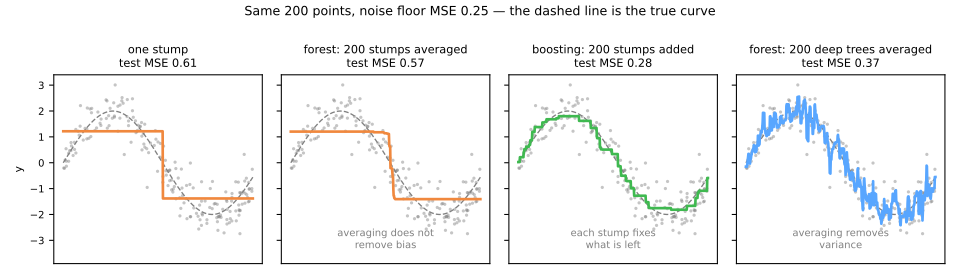
| 200 points, a sine | test MSE |
|---|---|
| one stump | 0.608 |
| forest of 200 stumps | 0.572 |
| boosting of 200 stumps | 0.280 |
| one deep tree | 0.509 |
| forest of 200 deep trees | 0.369 |
Noise floor: 0.25.
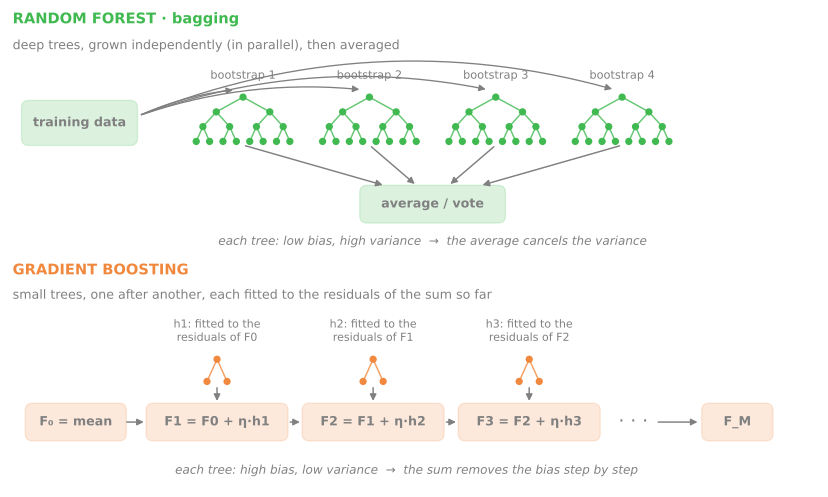
Averaging removes variance, not bias: 200 stumps averaged are still one step. Adding removes bias: stumps fitted to the errors follow the curve.
Two strategies, same building block
Stage 2 · what does each new tree learn?
Boosting by hand: six points
| \(x\) | 1 | 2 | 3 | 4 | 5 | 6 |
|---|---|---|---|---|---|---|
| \(y\) | 2 | 3 | 4 | 9 | 10 | 14 |
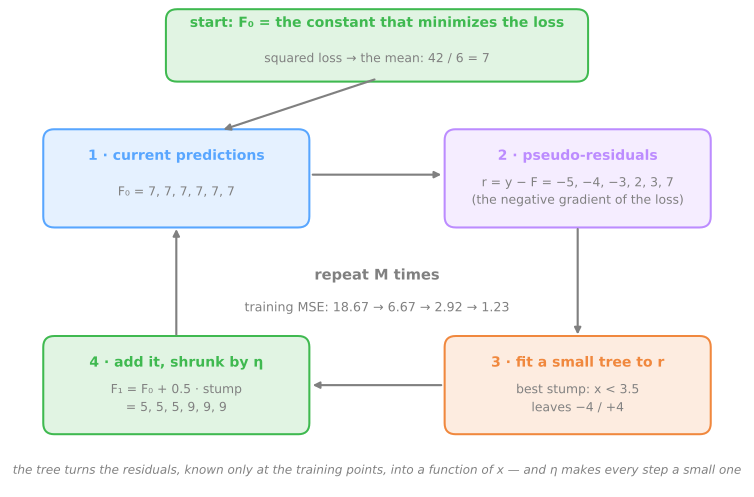
- Start with a constant: the mean, \(F_0 = 7\).
- Compute the residuals \(y - F_0\): −5, −4, −3, 2, 3, 7.
- Fit a stump to the residuals, not to \(y\): the best split is \(x < 3.5\), leaves −4 / +4 (SSE 16; the runner-up, 37).
- Add it, shrunk by \(\eta = 0.5\): \(F_1 = 5, 5, 5, 9, 9, 9\). Repeat.
The boosting loop
Three rounds
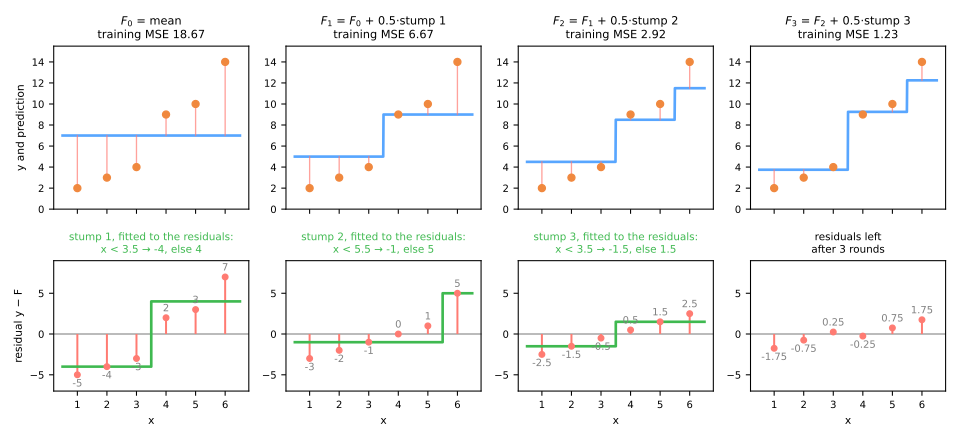
Training MSE: 18.67 → 6.67 → 2.92 → 1.23. Round 2 isolates the last point (residual 5); round 3 repeats the split of round 1: nothing forbids it.
GradientBoostingRegressor gives the same splits and leaves.Simulator: watch the residual shrink
Predict. The same loop on 60 points. Set ν = 1 with 6 stumps, then ν = 0.15 with 40: which one fits better, and how does each get there?
Stage 3 · why is it called gradient boosting?
Why "gradient": residuals are a gradient
\[ L(y, F) = \tfrac{1}{2}(y - F)^2, \qquad -\frac{\partial L}{\partial F} = y - F \]- The residual is the negative gradient of the loss with respect to the prediction.
- Boosting is gradient descent on the predictions; the tree turns the gradient, known only at the training points, into a function of \(x\).
F0(x) = the constant that minimizes Σ L(yᵢ, c)
for m = 1 .. M:
    rᵢ = −∂L(yᵢ, F)/∂F at F = F_{m−1}(xᵢ)     # pseudo-residuals
    fit a small tree h_m to (xᵢ, rᵢ)
    F_m(x) = F_{m−1}(x) + η · h_m(x)
Stage 4 · how many trees, and how big a step?
Learning rate and number of trees
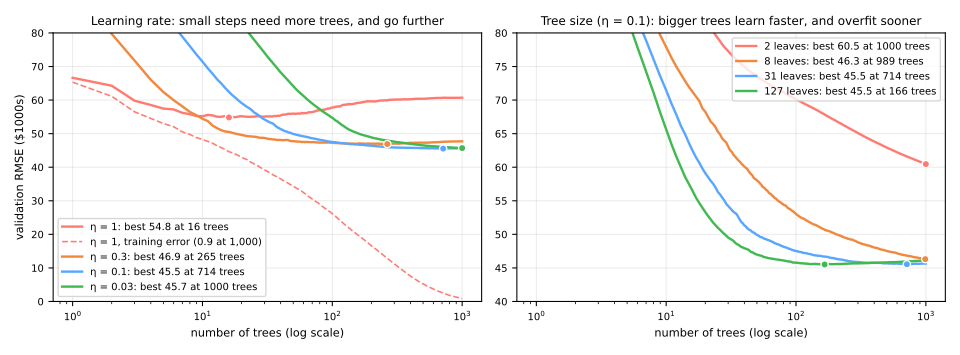
- \(\eta = 1\): lowest after 16 trees (54.8 thousand), then climbs to 60.7 while training falls to 0.9: overfitting by adding trees.
- A smaller \(\eta\) goes further: 46.9 with \(\eta = 0.3\), 45.5 with \(\eta = 0.1\) (714 trees).
Early stopping picks the number of trees
- It holds out a slice of the training data (
validation_fraction), measures the loss after each tree, and stops aftern_iter_no_changerounds without improvement.
| California housing | trees kept | validation RMSE |
|---|---|---|
| \(\eta = 1.0\) | 41 | 56.4 |
| \(\eta = 0.3\) | 87 | 47.4 |
| \(\eta = 0.1\) | 337 | 46.0 |
The number of trees becomes an output. With a large \(\eta\) the extra trees after the minimum already overfit; give small rates more patience.
Summary
- Averaging cuts variance; adding cuts bias.
- Each tree is fitted to the residuals and enters shrunk: \(F_m = F_{m-1} + \eta\, h_m\).
- The residuals are the negative gradient of the loss.
- More trees can hurt; a smaller \(\eta\) needs more trees and goes further.
- Early stopping picks the number of trees.
| symptom | what to do |
|---|---|
| validation lowest early, then rising | lower \(\eta\), switch on early stopping |
| metrics too good to be true | look for a column that knows the future |
Fundamental lab · about 35 min, in pairs
Who will subscribe? Steps 1 to 5
- A Portuguese bank's telemarketing: 45,211 clients, 11.7% subscribed to a term deposit. Metric: average precision (AP).
- A leak in plain sight; the default booster against logistic regression; the learning rate with early stopping.
- Notebook on Colab (in Portuguese): nothing to download; XGBoost and LightGBM preinstalled.
- At every step, answer the Predict before running.
- Simulations: a forest of stumps against a boosting of stumps (step 4) and more trees, no brakes (step 5).
Pace: steps 1 to 3 in 10 min; step 4 and the first simulation in 12 min; step 5 and the second in 13 min.