The path of this part
- Kinds of learningsupervised, unsupervised, reinforcement: by the feedback
- The project loopframe, get data, prepare, train, evaluate, deploy: a loop
- Generalizationtraining and new data; underfitting and overfitting
Learning paradigms: by the feedback
Machine learning (ML) problems are classified by the kind of feedback the learner gets.
Three paradigms
Supervised learning: inputs and the answers
The data contains inputs \(x\) and the desired outputs \(y\) (labels). Goal: learn a function \(f\) with \(f(x) \approx y\) on new data.
regression
\(y\) is continuous: house prices, energy demand, a patient's length of stay
classification
\(y\) is categorical: spam or not, benign or malignant tumor, which digit is in the image
Unsupervised learning: only the inputs
No labels. The goal is to discover structure.
clustering
group similar observations, e.g. customer segments
dimensionality reduction
compress many features into a few informative ones: PCA (principal component analysis), t-SNE, UMAP
topic modeling
discover themes in a collection of documents (BERTopic)
Reinforcement learning, and the mixtures
- An agent acts in an environment, receives rewards and learns a policy that maximizes long-term reward: game-playing systems (AlphaGo), robotic control.
- Out of scope for this course, but you should recognize it on the map.
semi-supervised
few labels, many unlabeled examples
self-supervised
labels manufactured from the data itself: how foundation models are pre-trained
weak supervision
noisy, programmatic labels
The ML workflow
A model is a small part of a larger, iterative process. The course is organized around this loop.
Two practical truths about the loop
most of the work is in steps 2–3
practitioners routinely report spending most of their time understanding and preparing data, not fitting models
the loop never ends
deployed models decay as the world changes (drift); monitoring and retraining are part of the job
Generalization: the central problem
It can still be useless. What matters is performance on data it has never seen.
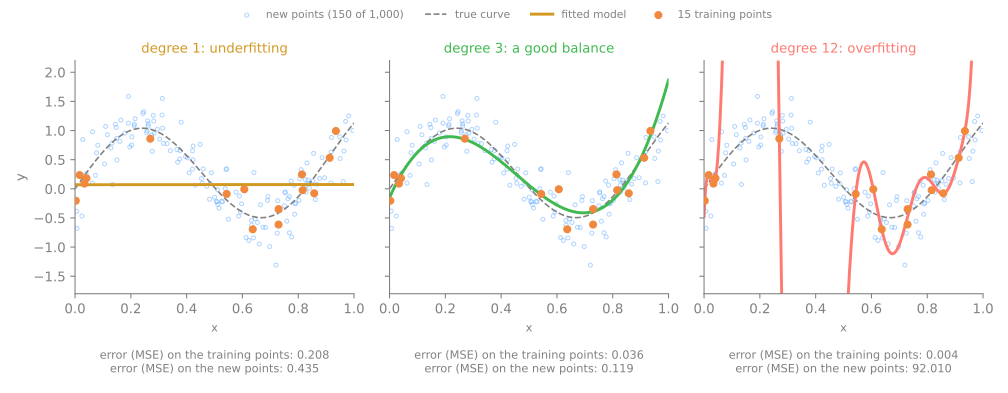
underfitting
too simple to capture the pattern: poor even on the training data
overfitting
captures noise as if it were signal: excellent on training, poor on new data
Three models, by eye
15 training points (orange) around a curve plus noise; 1,000 new points (blue) the models never see. Error: MSE (mean squared error), the average squared vertical distance. Predict: rank degrees 1, 3, 12 by training error. Same order on new points?
Simulator: underfitting and overfitting
Predict. As the degree goes from 1 to 15, what happens to the training error? And to the test error? Then press more data.
The golden rule
- In the lab and the simulator, "new points" come from a generator we wrote: we can draw the future at will.
- A real project has no such generator. The only stand-in for the future is data you set aside and never train on.
- Train/test splits, cross-validation, regularization, the bias–variance trade-off: all exist to manage this tension.
Summary
- Paradigms by feedback: supervised (labels), unsupervised (structure), reinforcement (rewards).
- In supervised learning the type of \(y\) names the task: regression or classification.
- The workflow is a loop, and most of the work is in the data.
- Read two errors, never one: both high is underfitting; training low and new-data high is overfitting.
- Only data the model never saw can judge it: never evaluate on the training data.
| what you see | what is happening |
|---|---|
| both errors high and close | underfitting: too simple |
| training tiny, new data much larger | overfitting: it memorized the noise |
| a deployed model slowly getting worse | drift: the world changed |
The shape of the error, steps 1 to 4
- A world you control: 15 training points around a curve, and 1,000 new points from the same process.
- Polynomials of growing degree, then a model that only memorizes: watch the training error and the error on new points.
- The code is on the lesson page: paste each block into a blank Colab notebook, in order. Nothing to install.
- At every step, answer the Predict before running.
- Simulations: more data (step 3) and nothing to learn (step 4).
Pace: steps 1 and 2 in 8 min; step 3 and the first simulation in 10 min; step 4 and the second in 12 min.