The path of this part
- Open and savenamed steps, learned values, one file
- Steps of your ownFunctionTransformer and a class that learns
- Tune through itstep__parameter and set_params
Each stage answers one question: what did each step learn, and how do we ship it? → how do we add a step scikit-learn does not have? → how does a search reach every setting?
Stage 1 · What did each step learn, and how do we ship it?
A fitted pipeline is a container you can open
list(full.named_steps)
full[-1]                   # indexing, like a list
full.named_steps['columntransformer'] \
    .named_transformers_['num'][0].statistics_
full[:-1].transform(X_test.head(2)).shape
['columntransformer', 'kneighborsregressor']
KNeighborsRegressor(n_neighbors=10)
[-118.5 34.2 29. 2129. 437. 1169. 411. 3.5]
(2, 13)
named_transformers_opens a branch of theColumnTransformer: the eight training medians the imputer will use (437 bedrooms).- A slice is a smaller pipeline:
full[:-1]is the preprocessing only, exactly what the model receives. print(full)gives the text diagram; in Jupyter the pipeline is drawn as a clickable diagram.
One file: preprocessing + model
joblib.dump(full, 'housing-knn.joblib')
loaded = joblib.load('housing-knn.joblib')
np.array_equal(loaded.predict(X_test), full.predict(X_test))   # True
3.9 MB on disk
k-NN (k-nearest neighbors) keeps all 16,512 training districts to find neighbors; most models store far less.
identical predictions
The loaded pipeline takes raw rows and returns the same predictions, to the last digit.
Whoever loads it cannot forget a step, re-fit a scaler or reorder the columns. Versions and safe loading are the subject of the lesson on MLOps (machine-learning operations).
Stage 2 · How do we add a step scikit-learn does not have?
Your own steps: stateless
log = FunctionTransformer(np.log1p, feature_names_out='one-to-one') # nothing to learn
| skewness of the four count columns | |
|---|---|
| before | 3.85, 3.32, 5.17, 3.26 |
| after \(\log(1+x)\) | −1.09, −1.0, −1.04, −1.06 |
Its
fit does nothing, so it cannot leak. 'one-to-one' keeps get_feature_names_out working.Your own steps: a transformer that learns
A clipper: learn the 1st and 99th percentiles of each column on the training rows, pull every value outside them back to the bound.
__init__only stores the hyperparameters.fitlearns and returnsself; learned state ends with_(lower_,upper_).transformapplies what was learned, after checking it was fit.TransformerMixingivesfit_transform;OneToOneFeatureMixinthe feature names.
learned on 16,512 districts
total_rooms: 162.2 to 11,248.0
$41,361
mean absolute error (MAE), slightly better than $41,552
A transformer that learns: the code
class Clipper(OneToOneFeatureMixin, TransformerMixin, BaseEstimator):
    def __init__(self, low=1, high=99):
        self.low = low                     # hyperparameters: stored, nothing else
        self.high = high

    def fit(self, X, y=None):
        X = validate_data(self, X)         # remembers the column names and count
        self.lower_ = np.percentile(X, self.low, axis=0)   # learned state ends with "_"
        self.upper_ = np.percentile(X, self.high, axis=0)
        return self

    def transform(self, X):
        check_is_fitted(self)
        X = validate_data(self, X, reset=False)            # same columns as in fit
        return np.clip(X, self.lower_, self.upper_)
It goes in the numeric branch, between the imputer and the scaler: make_pipeline(SimpleImputer(strategy='median'), Clipper(), StandardScaler()).
What the clipper is really for
Predict. One new district arrives with its
total_rooms multiplied by 1,000 (a unit error). What happens to its prediction, with and without the clipper?| true value | $65,600 |
| correct row | $90,030 |
| typo, no clipper | $251,020 |
| typo, clipper | $145,690 |
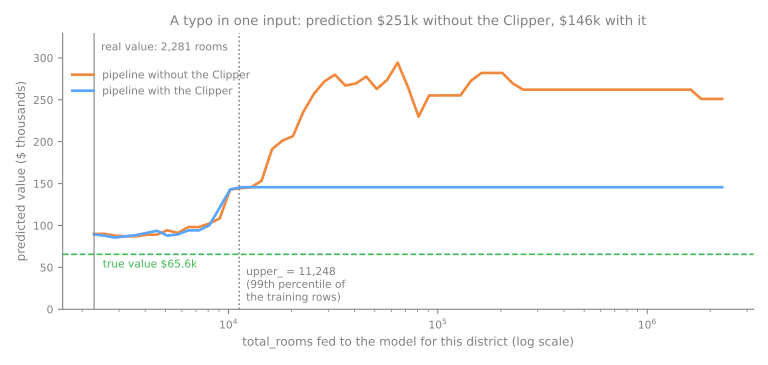
Still wrong, and no transformer can fix bad input. But the damage is bounded, and the bound was learned from training data only.
Stage 3 · How does a search reach every setting?
Looking ahead: tuning through the pipeline
full.get_params()        # 46 parameters, e.g. columntransformer__num__simpleimputer__strategy
full.set_params(kneighborsregressor__n_neighbors=20)
- Every setting of every step is reachable as
step__parameter. - A search that refits the whole pipeline re-learns the preprocessing on the training rows of each try.
Never choose a setting by looking at the test score: the cross-validation lesson does it honestly, with
GridSearchCV and these names.Summary
- A fitted pipeline is a container:
named_steps, indexing,named_transformers_; every learned value can be read. - One file holds the whole chain; the loaded pipeline takes raw rows.
- Nothing to learn:
FunctionTransformer. Something to learn: a class whosefitstores attributes ending in_. - Every setting is reachable as
step__parameter; a search refits the whole pipeline.
Design habit: write the pipeline skeleton first. The object you evaluate is the object you ship.
Advanced lab · about 30 min, in pairs
Open, use, save and extend the pipeline, steps 6 to 9
- Same notebook, same session: the steps use
preprocess,model,prep,X_trainandX_testfrom steps 1 to 5. - What the model sees (
set_output); new raw passengers; save, load, compare; a transformer of your own: the title. - Lab notebook, from step 6.
- Simulations: an encoder that refuses new categories (step 7) and how rare is "Rare"? (step 9).
Pace: steps 6 and 7 and the first simulation in 12 min; step 8 in 5 min; step 9 and the second in 13 min.