The path of this part
- Pieces of wordscharacter n-grams: plurals, typos, rhymes
- A real corpus99.90% zeros, CSR storage, the price of n-grams
- What raw counts put firstwords that are everywhere, one strange document
Each stage answers one question: what if we count pieces of words? → what does a real corpus look like as counts? → which words do raw counts put first?
Stage 1 · what if we count pieces of words?
Character n-grams
analyzer='char_wb' cuts each word, padded with spaces, into overlapping pieces of 3 letters.
| pair | cosine | shared trigrams |
|---|---|---|
| sábado / sábados | 0.77 | ' sá', 'ado', 'bad', 'sáb', 'ába' |
| gato / gatos | 0.67 | ' ga', 'ato', 'gat' |
| gato / pato (cat / duck) | 0.50 | 'ato', 'to ' |
They tolerate plurals, conjugations and typos, with no stemmer. The cost: "gato" and "pato" share spelling, not meaning.
Stage 2 · what does a real corpus look like as counts?
Sparsity: a real corpus
20 Newsgroups, training part: 11,314 posts, headers, signatures and quoted replies removed.
Predict. The vocabulary has 101,631 words. What fraction of the cells is zero?
zeros
99.90%
a median post uses 61 columns
as a dense array
9.2 GB
float64
as sparse CSR
13.3 MB
about 700 times less
Why vectorizers return sparse matrices
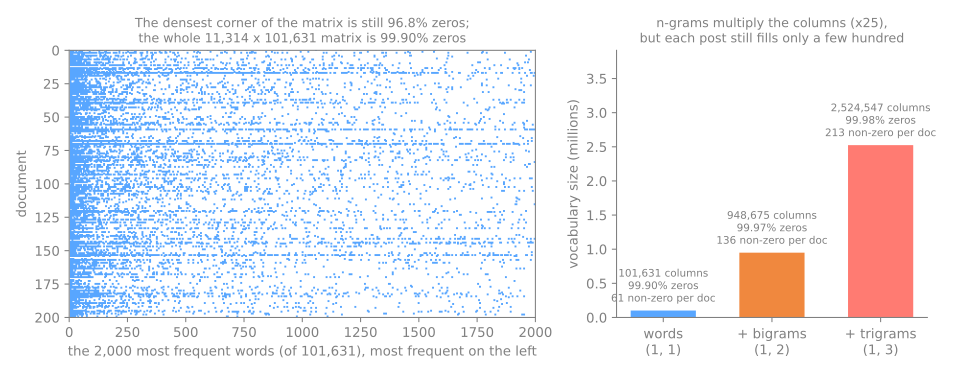
CSR (compressed sparse row) keeps only the non-zero values and their columns. Bigrams multiply the columns by 9, trigrams by 25; min_df=2 or max_features keep the size under control. .toarray() is for toy examples only.
Stage 3 · which words do raw counts put first?
What raw counts put first
Sum each column of the 11,314 posts and sort.
Predict. Which word comes first? And after removing the English stop words?
| vectorizer | top words | the leader |
|---|---|---|
| default | the, ax, to, of, and, in, is, that | "the": 106,381 times, in 9,475 posts |
stop_words='english' | ax, max, people, like, don, just, know, use | "ax": 62,387 times, in 20 posts |
Two problems, one cure
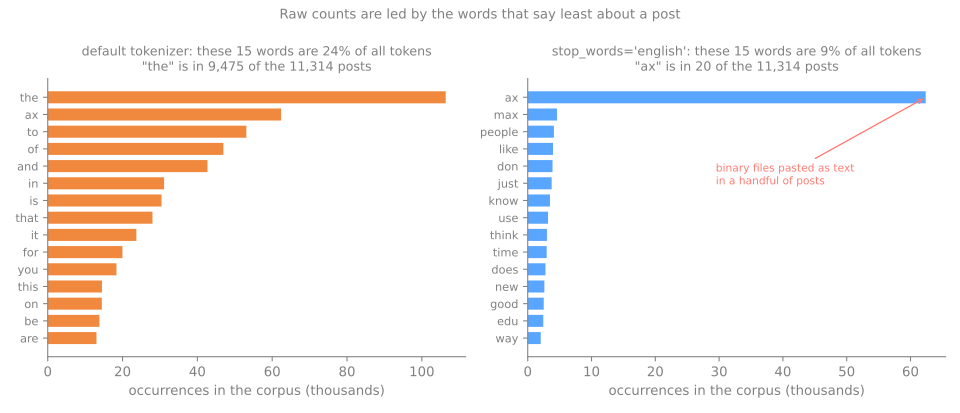
- Words in almost every post say nothing about the subject.
- "ax" repeats thousands of times in 20 posts with binary files pasted as text: one strange document dominates a column.
The cure, on the next page (E2.2 TF-IDF): weigh each word by how many documents contain it, not only by how often it occurs.
Summary
- Character n-grams match pieces of spelling: plurals and typos come close, and so do rhymes.
- A real count matrix is 99.90% zeros; CSR keeps only the non-zeros (13.3 MB instead of 9.2 GB).
- n-grams multiply the columns, and most of the new ones occur in a single post:
min_dfkeeps them in check. - Raw counts are led by words that are everywhere ("the") or by one strange document ("ax").
Next: TF-IDF (term frequency × inverse document frequency) weighs each word by how many documents contain it.
Advanced lab · about 15 min, in pairs
What the bag cannot see, steps 6 and 7
- Continue in the same notebook and session as steps 1 to 5.
- Step 6: n-grams of words and of characters, scored by the neighbor agreement.
- Step 7: a post with its words shuffled has the very same count vector.
- Simulation: how rare are n-grams? (step 6).
- The lab notebook, from step 6.
Pace: step 6 and the simulation in 10 min; step 7 in 5 min.