The idea
a column
for each word of the vocabulary
a row
for each document
a cell
how many times that word occurs in that document
The path of this lesson
- Count the wordsthe count matrix, CountVectorizer, counts or presence
- Compare two bagscosine similarity: the angle, not the distance
- What the bag losesword order; word and character n-grams
- A real corpussparsity, and what raw counts put first
Three documents, cut into tokens
"O gato comeu o peixe."               ['gato', 'comeu', 'peixe']
"O cachorro comeu a ração do gato."   ['cachorro', 'comeu', 'ração', 'do', 'gato']
"Gato dorme, gato sonha."             ['gato', 'dorme', 'gato', 'sonha']
the cat ate the fish · the dog ate the cat's food · cat sleeps, cat dreams
Counts, by hand
The vocabulary, sorted alphabetically: 8 words.
| cachorro | comeu | do | dorme | gato | peixe | ração | sonha | |
|---|---|---|---|---|---|---|---|---|
| d1 | 0 | 1 | 0 | 0 | 1 | 1 | 0 | 0 |
| d2 | 1 | 1 | 1 | 0 | 1 | 0 | 1 | 0 |
| d3 | 0 | 0 | 0 | 1 | 2 | 0 | 0 | 1 |
CountVectorizer builds the same matrix
bow = CountVectorizer()
X = bow.fit_transform(docs)
print(type(X).__name__, X.shape, 'non-zeros:', X.nnz)
print(bow.vocabulary_)
csr_matrix (3, 8) non-zeros: 11
{'gato': 4, 'comeu': 1, 'peixe': 5, 'cachorro': 0, 'ração': 6, 'do': 2, 'dorme': 3, 'sonha': 7}
fit learns the vocabulary, transform only applies it
The vectorizer above was fitted on the three documents. Now three new ones:
- "O gato comeu o gato." (the cat ate the cat)
- "O cachorro latiu." (the dog barked)
- "Um felino adormeceu." (a feline fell asleep)
Unseen words have no column
[[0 1 0 0 2 0 0 0]
 [1 0 0 0 0 0 0 0]
 [0 0 0 0 0 0 0 0]]
- "latiu" is silently dropped.
- "um felino adormeceu" is made only of unseen words: the zero vector.
Counts or presence: binary=True
[[0 1 0 0 1 1 0 0]
 [1 1 1 0 1 0 1 0]
 [0 0 0 1 1 0 0 1]]
d3's 2 under gato became 1.
short texts
titles, tweets, queries: a word rarely repeats, so both versions are almost identical
long documents
counts let one word that a post repeats many times dominate its vector
Comparing two bags: the cosine
\[ \cos(x_a, x_b) = \frac{x_a \cdot x_b}{\lVert x_a \rVert\, \lVert x_b \rVert} \]For counts: 0 (no word in common) to 1 (the same words in the same proportions).
By hand, then checked
d1, d2: \(x_1 \cdot x_2 = 1 + 1 = 2\)
\[ \cos = \frac{2}{\sqrt{3}\,\sqrt{5}} = 0.516 \]d1, d3: only gato, count 2 in d3
\[ \cos = \frac{2}{\sqrt{3}\,\sqrt{6}} = 0.471 \]
       d1     d2     d3
d1  1.000  0.516  0.471
d2  0.516  1.000  0.365
d3  0.471  0.365  1.000
cosine_similarity(X)
Why the angle and not the distance?
Paste d1 twice and compare the result with d1:
"O gato comeu o peixe."                          [0 1 0 0 1 1 0 0]
"O gato comeu o peixe. O gato comeu o peixe."    [0 2 0 0 2 2 0 0]
Euclidean distance
cosine
The length of a document is not what it is about
metric='cosine', or first divide each row by its length (which the TF-IDF vectorizer does by default).Word order is lost
- "O cachorro mordeu o homem." (the dog bit the man)
- "O homem mordeu o cachorro." (the man bit the dog)
| features | vectors | cosine |
|---|---|---|
| single words (3 columns) | [1, 1, 1] and [1, 1, 1] | 1.00 |
| + bigrams (7 columns) | "cachorro mordeu", "mordeu homem" only in the first; "homem mordeu", "mordeu cachorro" only in the second | 0.60 |
Bigrams buy back local order, at a price
- With single words the two sentences are the same vector: who bit whom is gone.
ngram_range=(1, 2)adds pairs of neighboring tokens and the cosine falls to 0.60.- The price: more columns, most of them rare.
Character n-grams
analyzer='char_wb' cuts each word, padded with spaces, into overlapping pieces of 3 letters.
| pair | cosine | shared trigrams |
|---|---|---|
| sábado / sábados | 0.77 | ' sá', 'ado', 'bad', 'sáb', 'ába' |
| gato / gatos | 0.67 | ' ga', 'ato', 'gat' |
| gato / pato (cat / duck) | 0.50 | 'ato', 'to ' |
Sparsity: a real corpus
20 Newsgroups, training part: 11,314 posts, headers, signatures and quoted replies removed.
zeros
as a dense array
as sparse CSR
Why vectorizers return sparse matrices
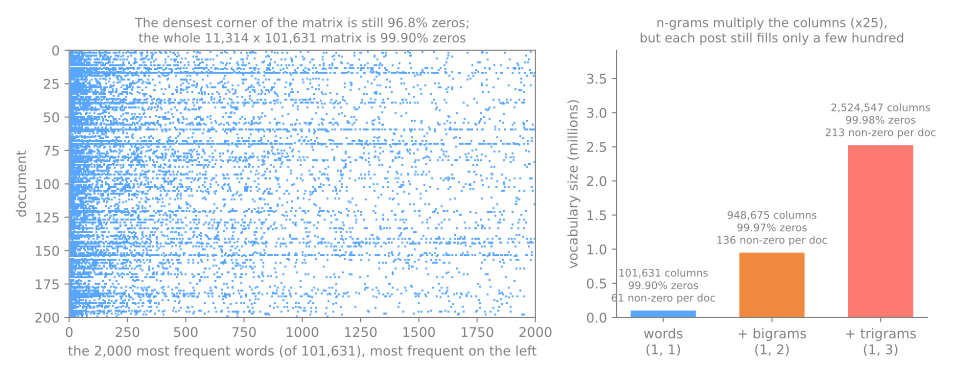
CSR (compressed sparse row) keeps only the non-zero values and their columns. Bigrams multiply the columns by 9, trigrams by 25; min_df=2 or max_features keep the size under control. .toarray() is for toy examples only.
What raw counts put first
Sum each column of the 11,314 posts and sort.
| vectorizer | top words | the leader |
|---|---|---|
| default | the, ax, to, of, and, in, is, that | "the": 106,381 times, in 9,475 posts |
stop_words='english' | ax, max, people, like, don, just, know, use | "ax": 62,387 times, in 20 posts |
Two problems, one cure
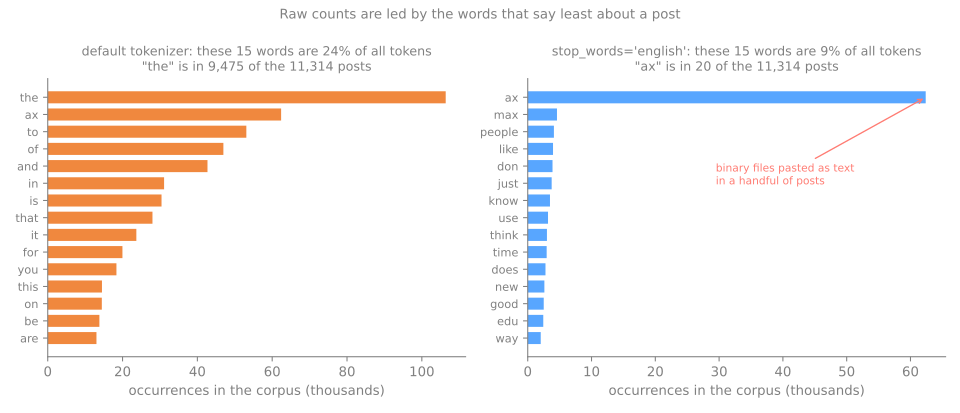
- Words in almost every post say nothing about the subject.
- "ax" repeats thousands of times in 20 posts with binary files pasted as text: one strange document dominates a column.
Simulator: build the bag yourself
Predict. Load the word-order preset: will the first two sentences get different vectors? Then tick add bigrams.
Summary
- A document becomes its word counts, one column per vocabulary word.
fitfixes the vocabulary; unseen words are dropped. Fit on training data only.- Compare documents with the cosine: length is not subject.
- Order is lost; bigrams and character n-grams buy some back, with many more columns.
- The matrix is 99.90% zeros: sparse storage is mandatory.
- Raw counts are led by words that are everywhere or in one strange document.
Bag-of-words on real posts
- Four newsgroups (computer graphics, baseball, electronics, Christianity), about 2,100 posts.
- One question: are the most similar posts about the same subject?
- Steps: load the posts · the count matrix · what each newsgroup talks about · shrinking the vocabulary · counts, presence, stop words · n-grams of words and characters · the bag cannot tell a post from its shuffled words.
- Download the lab notebook and open it in Jupyter or Colab.