Where the bag-of-words left us
words that are everywhere
one strange document
A stop list fixes the first problem, for one language and only for the words someone thought of listing.
The path of this lesson
- Weigh the wordstf × idf, the idf curve
- Compute and checkthree sentences by hand, scikit-learn, three knobs
- Compare and searchcosine, a small search engine, a real corpus
- Where it breakssynonyms, word order, two meanings, unseen words
The idea
Spärck Jones (1972): a term that occurs in many documents is a poor way to tell documents apart, so it should count less.
Salton & Buckley (1988), comparing many weighting schemes, made tf × idf with length normalization the standard of information retrieval.
scikit-learn's version
\[ \text{tf-idf}(t, d) = \underbrace{\text{tf}(t, d)}_{\text{count of } t \text{ in } d} \times \underbrace{\Big(\ln \frac{1 + n}{1 + \text{df}(t)} + 1\Big)}_{\text{idf}(t)} \]\(n\) documents, \(\text{df}(t)\) of them contain \(t\). Then every row is divided by its length (norm='l2').
"+1" inside the fraction
smooth_idf=True: as if one extra document contained every word once. No division by zero.
"+1" outside
a word in every document keeps weight 1, not 0: discounted, not deleted.
The idf curve
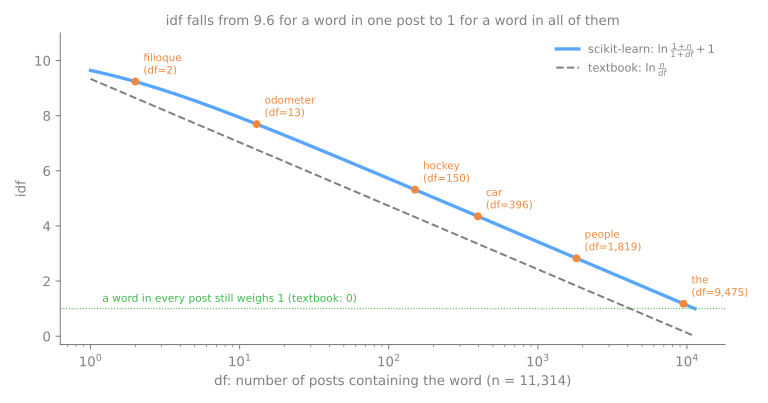
"filioque", in 2 posts: idf 9.2
"the", in nearly all: idf 1.18
By hand, on three sentences
| cachorro | comeu | do | dorme | gato | peixe | ração | sonha | |
|---|---|---|---|---|---|---|---|---|
| d1 | 0 | 1 | 0 | 0 | 1 | 1 | 0 | 0 |
| d2 | 1 | 1 | 1 | 0 | 1 | 0 | 1 | 0 |
| d3 | 0 | 0 | 0 | 1 | 2 | 0 | 0 | 1 |
the counts of the bag-of-words page: "O gato comeu o peixe.", "O cachorro comeu a ração do gato.", "Gato dorme, gato sonha."
Only three idf values
"gato", in 3 documents
\[ \ln\tfrac{4}{4} + 1 = 1 \]"comeu", in 2
\[ \ln\tfrac{4}{3} + 1 = 1.2877 \]every other word, in 1
\[ \ln\tfrac{4}{2} + 1 = 1.6931 \]Row d1, step by step
d1 = "gato comeu peixe", each word once.
| gato | comeu | peixe | |
|---|---|---|---|
| 1. tf × idf | 1 | 1.2877 | 1.6931 |
| 2. length | \(\sqrt{1^2 + 1.2877^2 + 1.6931^2} = \sqrt{5.5249} = 2.3505\) | ||
| 3. divide by it | 0.4254 | 0.5478 | 0.7203 |
scikit-learn confirms
tfidf = TfidfVectorizer()          # defaults: smooth_idf=True, norm='l2', sublinear_tf=False
T = tfidf.fit_transform(docs)
    cachorro   comeu      do   dorme    gato   peixe   ração   sonha
d1    0.0000  0.5478  0.0000  0.0000  0.4254  0.7203  0.0000  0.0000
d2    0.5046  0.3838  0.5046  0.0000  0.2980  0.0000  0.5046  0.0000
d3    0.0000  0.0000  0.0000  0.5427  0.6411  0.0000  0.0000  0.5427
same idf as by hand: True
Row d1 matches the hand computation to the fourth decimal. TfidfVectorizer = CountVectorizer + exactly this weighting.
Counts against TF-IDF
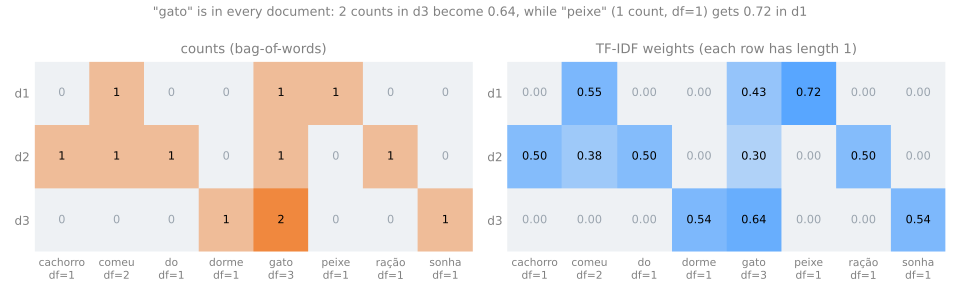
- In d1 and d2, "gato" now has the smallest non-zero weight: it is everywhere.
- In d3 it still has the largest (0.64): it occurs twice, and tf still counts.
Three knobs, on row d3
| option | dorme | gato | sonha |
|---|---|---|---|
| default | 0.5427 | 0.6411 | 0.5427 |
smooth_idf=False | 0.5864 | 0.5588 | 0.5864 |
sublinear_tf=True | 0.5774 | 0.5774 | 0.5774 |
norm=None | 1.6931 | 2 | 1.6931 |
smooth_idf=False: \(\ln(n/\text{df}) + 1\); the rare words get \(\ln 3 + 1 = 2.0986\) and overtake "gato".sublinear_tf=True: count → \(1 + \ln(\text{tf})\); the two "gato" count \(1.6931\), equal to the rare words' idf by coincidence.norm=None: raw products; longer documents get larger vectors (matters for Euclidean distance, not for the cosine).
Comparing documents: the cosine is a dot product
TF-IDF rows have length 1, so the cosine is just their dot product. d1 and d2 share comeu and gato:
\[ \cos(d_1, d_2) = 0.5478 \times 0.3838 + 0.4254 \times 0.2980 = 0.2102 + 0.1268 = 0.337 \]d1 and d3 share only gato: \(0.4254 \times 0.6411 = 0.273\).
Every similarity went down
counts
       d1     d2     d3
d1  1.000  0.516  0.471
d2  0.516  1.000  0.365
d3  0.471  0.365  1.000
TF-IDF
       d1     d2     d3
d1  1.000  0.337  0.273
d2  0.337  1.000  0.191
d3  0.273  0.191  1.000
A small search engine
A help-desk FAQ of ten questions. Turn the query into a vector with the same fitted vectorizer, rank the questions by cosine.
- "esqueci minha senha" (I forgot my password)
- "erro 0x80004005" (an error code)
- "quero contestar a correção do exame" (I want to contest the grading of the exam)
- "onde almoçar no sábado" (where to have lunch on Saturday)
- "perdi a fatura" (I lost the invoice)
Two work, three fail
| query | score | best match | words used |
|---|---|---|---|
| esqueci minha senha | 0.35 | FAQ 0: trocar a senha… | senha |
| erro 0x80004005 | 0.53 | FAQ 9: o erro 0x80004005… | erro, 0x80004005 |
| quero contestar a correção do exame | 0.51 | FAQ 0: trocar a senha… | do |
| onde almoçar no sábado | 0.37 | FAQ 2: segunda via do boleto… | onde |
| perdi a fatura | 0.00 | FAQ 0 (first by default) | — |
- A rare token has a high idf: an exact code is the ideal TF-IDF query.
- "contestar a correção do exame" shares only "do"; the right answer ("revisão da nota de uma prova") uses none of its words.
- The restaurant entry says "sábados", not "sábado": a stemmer would fix that one.
A stop list removes false matches, but cannot create true ones
quero contestar a correção do exame   best score 0.00
onde almoçar no sábado                best score 0.00
On a real corpus
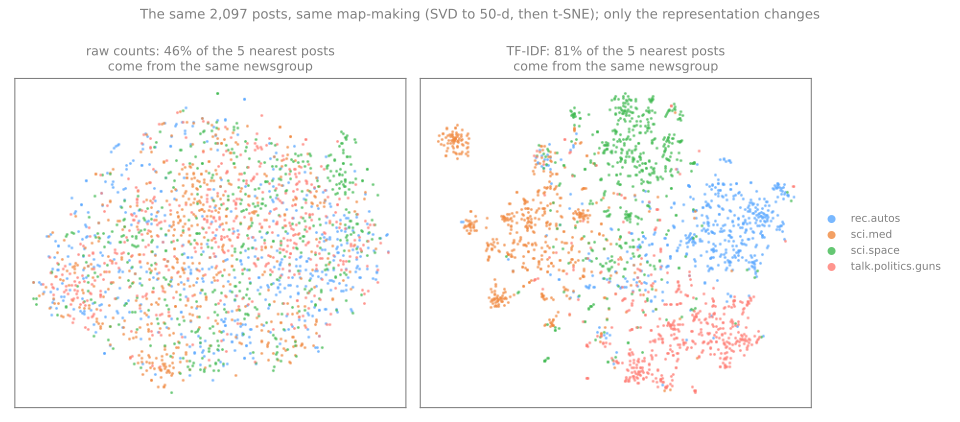
2,097 posts from four newsgroups, reduced with a truncated SVD (singular value decomposition) and drawn with t-SNE (the color is the newsgroup). Nearest 5 posts from the same newsgroup: counts 46%, TF-IDF 81% (random: about 25%).
The limits of sparse representations
Each word is its own axis, orthogonal to every other word.
| pair | cosine | shared words |
|---|---|---|
| synonyms: o carro é rápido / o automóvel é veloz | 0.00 | none |
| word order: o cachorro mordeu o homem / o homem mordeu o cachorro | 1.00 | cachorro, homem, mordeu |
| two meanings: a manga da camisa rasgou / comi uma manga madura | 0.14 | manga |
| same meaning: a manga da camisa rasgou / o punho da blusa descosturou | 0.14 | da |
And a fifth: unseen words have no column
'o cachorro latiu'       non-zeros: 1   {'cachorro': 1.0}
'um felino adormeceu'    non-zeros: 0   {}
"a feline fell asleep": a sentence about a cat sleeping, next to documents about cats sleeping, with similarity 0 to all of them.
Simulator: TF-IDF and search, live
Predict. In the lesson preset, untick smooth_idf: will the idf of the rare words go up or down? Then try the synonyms preset.
Summary
- idf discounts words by the number of documents that contain them; tf still counts repetitions.
- scikit-learn: \(\ln\frac{1+n}{1+\text{df}} + 1\), then each row divided by its length.
- Rows of length 1: the cosine is a dot product.
- Search: the same fitted vectorizer for documents and query; exact rare tokens are its strength.
- Every word is its own axis: synonyms score 0, order is invisible, new words vanish.
A TF-IDF search engine on real posts
- Four newsgroups (computer graphics, baseball, electronics, Christianity), about 2,100 posts.
- Steps: load the posts · the TF-IDF matrix and its idf · what a post is about, in eight words · the most similar posts · which options give the best neighbors? · a keyword search engine · what keyword search cannot see.
- Download the lab notebook and open it in Jupyter or Colab.