The path of this part
- Other roadsLSA, GloVe, fastText
- Analogies under the microscopethe exclusion rule; offsets measured
- Biasa gender direction and its caveats
The same compression on documents: LSA
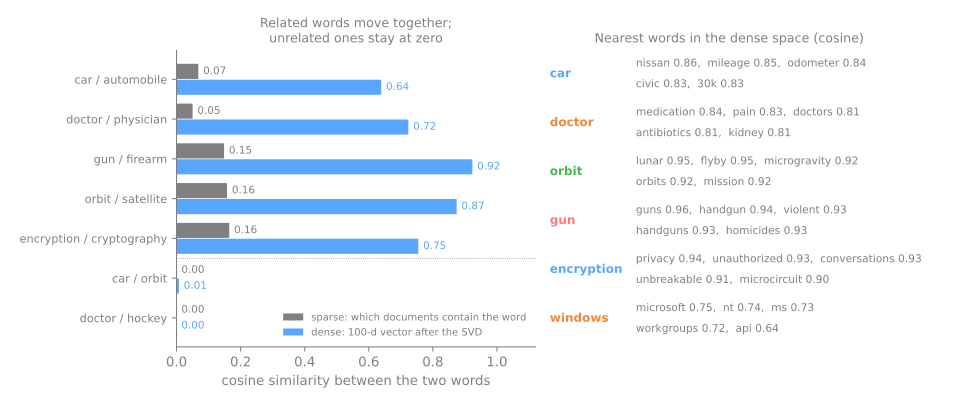
Latent semantic analysis (LSA, Deerwester et al., 1990): truncated SVD (singular value decomposition) of the TF-IDF matrix (term frequency × inverse document frequency), 11,314 posts, 100 components.
car/automobile 0.07 → 0.64; gun/firearm 0.15 → 0.92; unrelated pairs stay at 0.00–0.01.
GloVe and fastText
GloVe (global vectors, Pennington et al., 2014)
Back to counting: fit vectors whose dot products approximate the log of the co-occurrence counts of a huge corpus.
fastText (Bojanowski et al., 2017)
A word is the sum of its character n-grams:
latiu → <la, lat, ati, tiu, iu>, <lat, lati, …
6 pieces shared with latido
The quiet trick: the input words are excluded
Predict. most_similar never returns an input word. Without that rule, what is nearest to king − man + woman?
| nothing excluded | nearest three |
|---|---|
| king − man + woman | king 0.89, queen 0.85, throne 0.77 |
| doctor − man + woman | doctor 0.90, nurse 0.84, child 0.77 |
- "doctor − man + woman = nurse" appears only because "doctor" is forbidden (Nissim et al., 2020).
- cos(king − queen, man − woman) = 0.58; an unrelated offset: −0.05.
Bias: what the vectors learned about people
Average 8 differences (he − she, man − woman, …) into a gender direction; project occupations on it.
| receptionist | −0.31 |
| nurse | −0.30 |
| teacher | 0.00 |
| engineer | 0.24 |
| manager | 0.37 |
| captain | 0.42 |
For reference: she −0.19, he 0.24. Receptionist leans further to "she" than "she"; captain further to "he" than "he".
Reading a bias table with care
the direction is estimated
From 8 pairs of words. One pair alone can be noisy: "man" projects to only +0.10.
a word moves for other reasons
In news, "captain" is often a sports or military title, not only a gendered role.
- A system that ranks résumés by similarity to a job description inherits the lean.
- Projecting the direction out (Bolukbasi et al., 2016) hides the bias more than it removes it.
Summary
- A whole document as the context (LSA) gives neighbors of the same topic; a small window gives neighbors of the same kind.
- GloVe fits the log of global co-occurrence counts; fastText builds a word from its character pieces, so unseen words get vectors, and spelling neighbors creep in.
most_similarexcludes the input words: much of the famous analogy accuracy comes from forbidding the obvious wrong answer.- A gender direction exposes stereotypes the vectors compressed from their text; read it with its caveats.
Scoring the vectors, steps 6 to 8
- Same notebook, same session: the steps use
vocab,pos,chunks,W_svd,W_w2v,W_gloveandglove. - The analogy test (3,732 questions), fastText on words never seen, and a map of the space with PCA (principal component analysis) and t-SNE (t-distributed stochastic neighbor embedding).
- Simulations: the exclusion rule at scale (step 6) and does the map keep the neighbors? (step 8).
Pace: step 6 and the first simulation in 10 min; step 7 in 6 min; step 8 and the second in 9 min.