The problem: every word is its own column
- In bag-of-words and TF-IDF the columns are orthogonal.
- "car" and "automobile" are exactly as unrelated as "car" and "banana".
- The representation knows which words a document contains, nothing about what they mean.
The path of this part
- Context → meaningthe distributional hypothesis
- Count and compressco-occurrence counts → PPMI → truncated SVD
- Learn by predictingskip-gram, CBOW, negative sampling
- Explore the spaceneighbors, relatedness, analogies, one vector per word
A word you have never seen
- Um copo de tiquira gelada. (A glass of cold tiquira.)
- A tiquira é feita de mandioca fermentada. (… made from fermented cassava.)
- Bebeu tiquira demais e passou mal. (He drank too much … and felt sick.)
- No Maranhão, servem tiquira nas festas. (… they serve it at parties.)
The distributional hypothesis
You inferred it from the company it keeps: glass, cold, fermented, drank, too much, parties.
Harris, 1954
words that occur in similar contexts tend to have similar meanings
Firth, 1957
"you shall know a word by the company it keeps"
From counts to PPMI, step by step
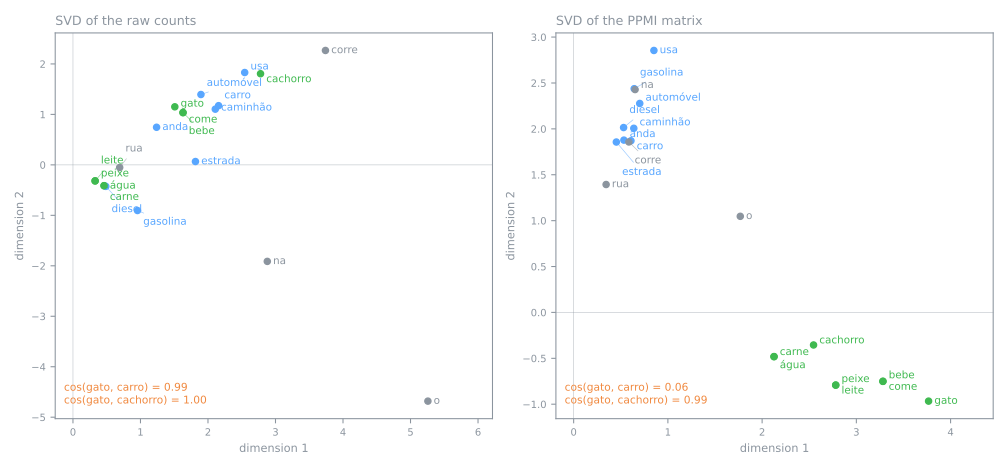
Eleven sentences, a window of two words; PMI = pointwise mutual information. Predict. In raw counts, which context of "gato" is the strongest? After PMI, which one is the weakest?
Truncated SVD: 20 sparse columns → 2 dense numbers
| word | dim 1 | dim 2 |
|---|---|---|
| gato | 3.77 | −0.97 |
| cachorro | 2.55 | −0.35 |
| leite | 2.78 | −0.79 |
| carro | 0.61 | 1.87 |
| automóvel | 0.70 | 2.28 |
| gasolina | 0.64 | 2.44 |
The SVD (PCA, principal component analysis, without centering) keeps the \(k\) directions that explain most of the matrix.
Animals and food: big first coordinate. Vehicles and fuel: big second.
The whole section in four columns
| pair | bag-of-words columns | counts | PPMI | PPMI + SVD |
|---|---|---|---|---|
| gato / cachorro | 0.00 | 0.73 | 0.22 | 0.99 |
| carro / automóvel | 0.00 | 0.87 | 0.75 | 1.00 |
| gato / carro | 0.00 | 0.50 | 0.05 | 0.06 |
word2vec: learning by prediction
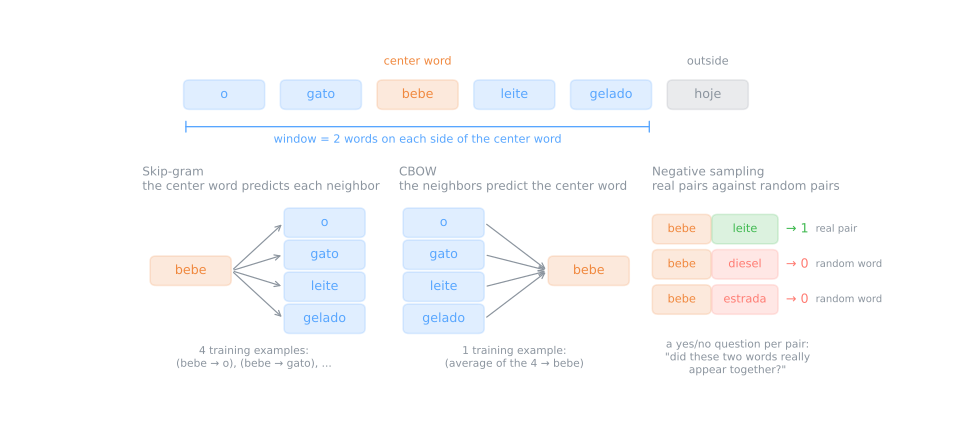
Mikolov et al., 2013. Slide a window and make training examples:
- skip-gram: the center predicts each neighbor → 18 examples from 6 words;
- CBOW (continuous bag-of-words): the averaged neighbors predict the center → 6 examples.
How the vectors drift together
- Every word starts with a random vector. A pair (center, context) is scored by the dot product.
- Training nudges the vectors so that pairs that really occur score high.
- Words in the same contexts get the same nudges: the distributional hypothesis as an optimization.
negative sampling
Instead of scoring all 100,000 words: "did these two really appear together?" Real (bebe, leite) → 1; random (bebe, diesel) → 0, with 5 to 20 random words per real pair.
Training it: the knobs of gensim
| parameter | what it does |
|---|---|
vector_size | numbers per word (100 to 300 is typical) |
window | small (2–5): same function; large (10+): same topic |
sg | 1 = skip-gram (slower, better for rare words); 0 = CBOW |
negative | random words per real pair |
min_count | rarer words are dropped |
epochs, seed | passes; seed and workers=1 for reproducibility |
Pretrained vectors: GloVe, 400,000 words × 50 numbers
| word | nearest by cosine |
|---|---|
| car | truck 0.92, cars 0.89, vehicle 0.88, driver 0.85, driving 0.84 |
| mango | pineapple 0.91, guava 0.90, papaya 0.89, pear 0.85, coconut 0.85 |
| brazil | portugal 0.88, argentina 0.87, rica 0.84, spain 0.83, costa 0.83 |
| python | reticulated 0.69, spamalot 0.66, php 0.64, owl 0.63, mouse 0.63 |
GloVe (global vectors): trained at Stanford on 6 billion tokens. No single number means anything ("car" starts with 0.48, −0.08, 1.46…); only the geometry does. "python" mixes the snake, Monty Python and programming.
Similar is not synonymous
| car / automobile | 0.70 |
| doctor / physician | 0.80 |
| hot / cold | 0.80 |
| good / bad | 0.80 |
| car / banana | 0.22 |
An antonym is the most interchangeable word there is: "the soup is hot" / "the soup is cold".
Analogies, measured honestly
\(\text{king} - \text{man} + \text{woman} \approx\ ?\)
hits
queen · tokyo · rome · swam · faster · worse · spanish
misses
- bigger − big + small = larger
- brother − man + woman = daughter
- glove − hand + foot = "50,000-square"
Capitals, tenses, comparatives and languages mostly work; rare relations are not straight directions.
Simulator: seeing the space
Predict. Click a word and compare its neighbors in 50-D (the lines) with the map: does the PCA map (24.5% of the variance) lie? Then try a preset analogy.
The limit: one vector per word
bank
banks, securities, banking, investment, exchange, financial…
bank/money 0.64 · bank/river 0.41
apple
blackberry, chips, iphone, microsoft, ipad…
the fruit is nowhere in the top ten
- A vector is roughly a frequency-weighted average of the senses (Arora et al., 2018). Portuguese: banco, manga, vela.
- "The dog bit the man" / "the man bit the dog": same words, so word vectors alone cannot tell who bit whom.
Summary
- Distributional hypothesis: similar contexts → similar vectors.
- By hand: co-occurrence counts → PPMI (keep what beats chance) → SVD (merge contexts that behave alike).
- word2vec predicts the neighbors; with negative sampling, yes/no questions. It lands near the same place as counting.
- Pretrained vectors: neighbors measure relatedness (antonyms too); analogies work part of the time.
- One vector per word, whatever the sense.
Word vectors three ways, steps 1 to 5
- The first million words of text8 (English Wikipedia, cleaned).
- Counting (PPMI + SVD), prediction (word2vec) and pretrained (GloVe), compared by their neighbors on the same words.
- Download the lab notebook and open it in Colab or Jupyter; in Colab run
!pip install gensimfirst. - At every step, answer the Predict before running.
- Simulations: what PPMI is for (step 3) and skip-gram or CBOW (step 4).
Pace: steps 1 and 2 in 8 min; step 3 and the first simulation in 10 min; step 4 and the second in 10 min; step 5 in 7 min.