The path of this part
- Why embeddingsshort documents share few words
- Embed and reduce384 numbers per post, then UMAP to 5
- ClusterHDBSCAN; outliers are topic −1
- Describec-TF-IDF, the cluster as a document
- In one callthe BERTopic class, same partition
Short documents: where word counts run out
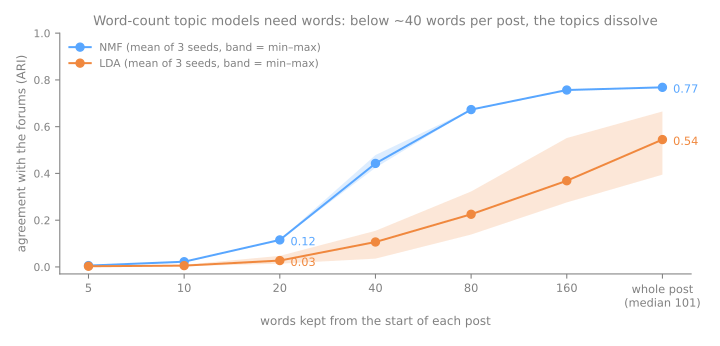
LDA (latent Dirichlet allocation) and NMF (non-negative matrix factorization) see only word counts. With the first 20 words of each post, ARI (adjusted Rand index) with the forums: NMF 0.12, LDA 0.03.
Meaning as distance
TF-IDF cosine
embedding cosine
On the 20-word posts, plain k-means on the embeddings reaches ARI 0.582, five times NMF's.
BERTopic: four steps, each a lesson you know
Step 1 — embed
Each post → 384 numbers with all-MiniLM-L6-v2 (a small English sentence-transformer, fast on a CPU).
TF-IDF
embeddings
Step 2 — reduce with UMAP
- In 384 dimensions distances concentrate: density-based clustering suffers.
- UMAP (uniform manifold approximation and projection) to 5 dimensions, not 2: the goal is to cluster, not to draw.
min_dist=0.0packs similar points tightly, which a density clusterer wants.
random_state.Step 3 — cluster with HDBSCAN
HDBSCAN (hierarchical density-based clustering) finds dense regions of any shape; one main knob, min_cluster_size=10.
clusters
min_cluster_size and the densityoutliers (−1)
pure
Hockey (516) and religion (554) are one big cluster each; graphics and space break into many small ones (file formats, graphics cards, the Moon…).
Simulator: min_cluster_size, one value at a time
Predict. Raise min_cluster_size from 2 to 40: will the number of topics fall smoothly?
Step 4 — describe each cluster with c-TF-IDF
Join the documents of a cluster into one pseudo-document, then a class-based TF-IDF (c-TF-IDF):
\[ \text{c-TF-IDF}(t, c) = \frac{n_{t,c}}{\sum_{t'} n_{t',c}} \times \log\!\Big(1 + \frac{A}{f_t}\Big) \]- \(n_{t,c}\): count of word \(t\) in cluster \(c\); the denominator: all the words of \(c\)
- \(f_t\): count of \(t\) over all clusters · \(A\): average words per cluster
c-TF-IDF by hand, step by step
The nine single-theme sentences as three clusters. Predict. team appears 3 times, game twice, both only in sports: which gets the larger weight, and which the larger score?
All four steps in one call
The same objects and the embeddings of step 1 in BERTopic(...): same partition (ARI 1.0), renumbered by size.
| topic | posts | Name |
|---|---|---|
| −1 | 431 | -1_space_jpeg_launch_image |
| 0 | 567 | 0_god_jesus_people_church |
| 1 | 520 | 1_team_game_hockey_play |
| 2 | 66 | 2_image_graphics_package_processing |
| 3 | 55 | 3_card_mode_vesa_vga |
| 4 | 52 | 4_moon_lunar_prize_money |
| 5 | 43 | 5_space_nasa_shuttle_astronaut |
| 6 | 41 | 6_van_het_orbit_een |
Summary
- Short documents share few words; a sentence embedding puts same-meaning documents close anyway.
- Four independent steps: embed → UMAP → HDBSCAN → c-TF-IDF.
- HDBSCAN sets the number of topics; sparse posts go to topic −1.
- c-TF-IDF names a cluster by words frequent in it and rare elsewhere.
To close the fundamental part
- Why does BERTopic reduce the embeddings to 5 dimensions and not 2?
- What does topic −1 hold, and why do LDA and NMF have nothing like it?
- Why is game weighted more than team, and still scores less in sports?
In the lab: steps 4 to 7 and the simulation the embeddings or HDBSCAN? (overview page). Next: the fundamental slides of E3.4 Comparing the Models.