The path of this part
- Three setstrain, validation, test; why validation wears out
- One split → k foldsthe lottery of one split; k-fold: k parts take turns validating; mean ± std
- Honest foldsthe right splitter, preprocessing refit in every fold
- The honest recipefive rules, then the lab: tune C with a grid search
Three sets, three roles
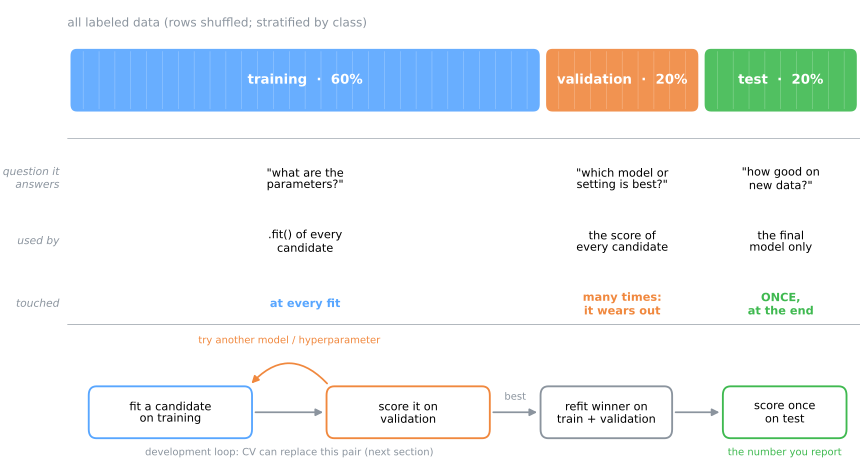
| train | the model learns its parameters here | touched always |
| validation | chooses between models and hyperparameters | touched many times |
| test | simulates the future | touched once |
Why a set you choose on stops being honest
Pure noise: 20 random columns, a coin-flip target. No model can beat 50%. Train 100 trees with random hyperparameters and keep the best on validation.
Predict. The winner scores above 50% on validation. What will the same tree score on untouched data? Does the gap grow or shrink as you compare more configurations?
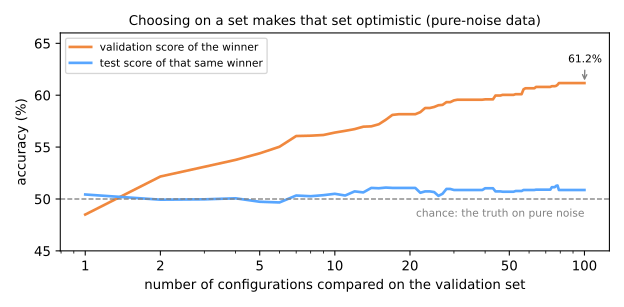
This is the winner's curse: the bias grows with the number of things you tried.
A single split is a lottery
Predict. Only the random_state of the split changes. How far apart can two reported accuracies be? And two means of a 5-fold CV?
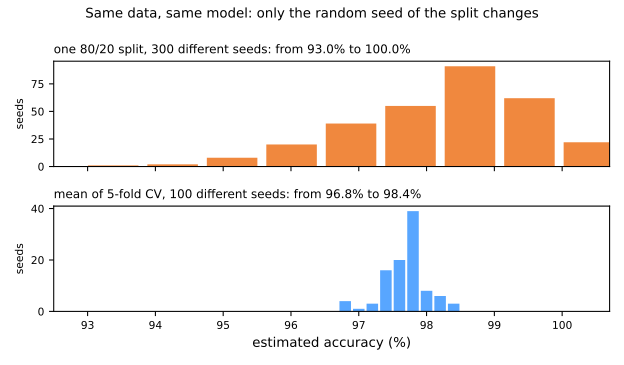
Same model, same data, 300 seeds of an 80/20 split:
| one hold-out | 93.0% to 100.0% |
| 5-fold CV mean | 96.8% to 98.4% |
CV greatly reduces the luck of the split; it cannot remove the luck of the sample — all folds come from the same rows.
Simulator: the luck of the split
Predict. With \(n = 80\) rows (\(n\) = number of rows), press Draw 100: which band is wider, the hold-out or the CV mean? Then press New dataset a few times: does the CV band stay on the white line?
k-fold, step by step
Cut the training data into \(k\) folds; each round trains on the other \(k-1\) and scores on the one left out; report the mean and the standard deviation of the \(k\) scores.
k-fold in code
The CV runs on X_train only: the test set stays locked away, as in the diagram.
cv = StratifiedKFold(n_splits=5, shuffle=True, random_state=42)
scores = cross_val_score(pipe, X_train, y_train, cv=cv, scoring='f1')
print(f"{scores.mean():.3f} ± {scores.std():.3f}")
The spread is information too
- If the folds give 0.97 · 0.96 · 0.98 · 0.71 · 0.97, the mean hides a model that fails badly on some subset. That fold deserves a look.
- A recall of 0.95 ± 0.05 and one of 0.95 ± 0.005 are very different statements.
Choosing a CV scheme
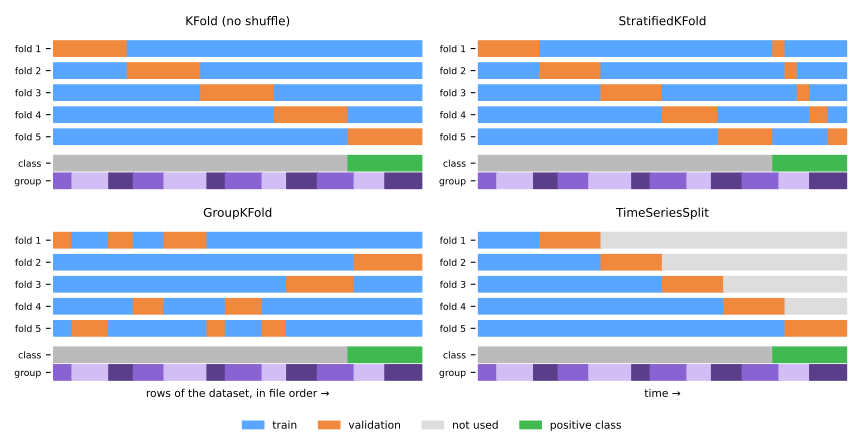
The splitters differ in which rows may land together in a validation fold.
Which splitter to use
| method | when to use | watch out for |
|---|---|---|
| K-Fold | regression, balanced data (with shuffle=True) | folds with no rows of a rare class |
| Stratified K-Fold | classification, especially imbalanced | only stratifies on the target |
| Leave-One-Out | very small datasets | \(n\) fits (\(n\) = number of rows); one row per fold: no per-fold std |
| TimeSeriesSplit | temporal data | early folds train on little; gap if the target looks ahead |
| Group K-Fold | grouped data (patients, users) | needs a group column |
Predict. 100 rows, 8 positives, KFold shuffled into 5 folds: how often does some fold get no positive at all?
Preprocessing restarts in every fold
Predict. If the scaler is fit on all of X before CV, will the score come out higher, lower or about the same? And if the step were a feature selector that looks at y?
# WRONG: the validation rows' statistics leak into training
X_scaled = StandardScaler().fit_transform(X)
cross_val_score(LogisticRegression(), X_scaled, y, cv=cv)

# RIGHT: each fold gets its own scaler
pipe = make_pipeline(StandardScaler(), LogisticRegression())
cross_val_score(pipe, X, y, cv=cv)
- Scaling, encoding, imputation and feature selection must be refit inside each fold.
- In a
Pipeline, every step is fit only on the fold's training portion and applied frozen to its validation portion.
The honest-validation recipe
- Lock the test set away, with
stratifyfor classification. - Replace the split with CV:
StratifiedKFold(5, shuffle=True, random_state=...). - Build each candidate as a
Pipeline, with every fitted step inside. - Report mean ± std and look at the individual folds.
- Reuse a single
cvobject across candidates — the comparison becomes paired.
Breast cancer: CV in action, steps 1 to 6
- 569 tumours, 30 measurements; the metric is recall on the malignant class.
- Notebook on Colab (in Portuguese): nothing to download. Save a copy to your Drive.
- In each step, answer the Predict before running.
- Simulations: the luck of the split, measured (step 4) and the one-standard-error rule (step 6).
Pace: steps 1 to 3 in 10 min; step 4 and its simulation in 12 min; steps 5 and 6 with the simulation in 13 min.