Clean Architecture
Clean Architecture was proposed by Robert C. Martin (Uncle Bob) as a synthesis of several earlier layered-architecture ideas — Hexagonal, Onion, and BCE. Its central rule is the Dependency Rule: source-code dependencies must always point inward, toward higher-level policy1.
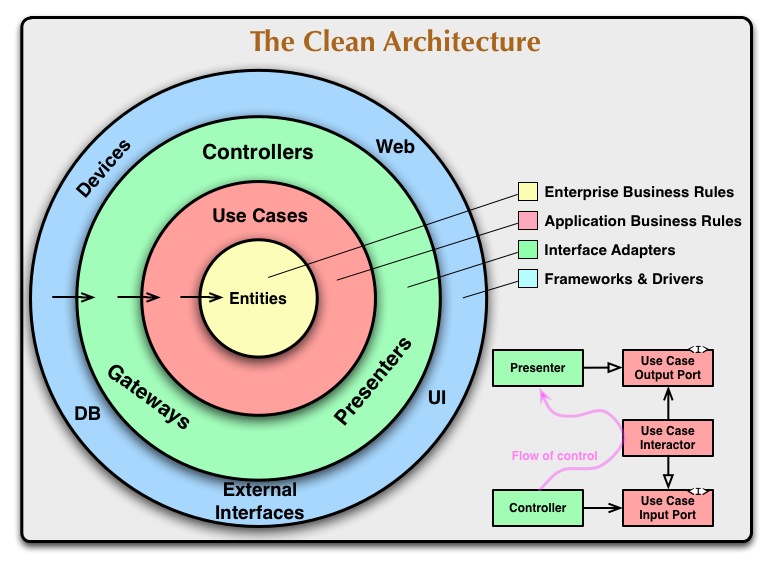
Layers
| Layer | Also called | Responsibility |
|---|---|---|
| Entities | Domain | Enterprise-wide business rules and data structures. Independent of any application. |
| Use Cases | Application | Application-specific business rules. Orchestrates Entities; defines what the app does. |
| Interface Adapters | Adapters | Converts data between Use Cases and external formats: Controllers, Presenters, Gateways. |
| Frameworks & Drivers | Infrastructure | Web frameworks, databases, UI, external APIs. The outermost ring — all detail lives here. |
The Dependency Rule
Nothing in an inner layer may reference anything in an outer layer. Data that crosses boundaries must be in simple structures — plain objects or records — never a framework type. An @Entity annotation or HttpServletRequest must never appear inside a Use Case or Entity class.
What belongs where
A practical heuristic for deciding which layer a class belongs to:
- If it changes when the business changes → Entity or Use Case
- If it changes when the interface changes (REST → gRPC, JSON → XML) → Interface Adapter
- If it changes when a library is upgraded (Spring Boot version, JPA dialect) → Frameworks & Drivers
In our architecture
The diagram below shows how Clean Architecture layers map to the classes and packages used in the course's Spring Boot microservices:
flowchart LR
  subgraph Adapters ["Interface Adapters (green)"]
    direction TB
    Interface:::adapter
    RecordIn:::adapter
    RecordOut:::adapter
  end
  subgraph UseCases ["Use Cases (red)"]
    direction TB
    Service:::usecase
    DTO:::usecase
  end
  subgraph Entities ["Entities (yellow)"]
    direction TB
    Repository:::entity
    Table:::entity
  end

  Interface --> RecordIn
  Interface --> RecordOut

  Adapters <-->|Parser| UseCases
  Service --> DTO
  UseCases <-->|Mapper| Entities
  Repository --> Table

  classDef adapter fill:#6f6
  classDef usecase fill:#f99
  classDef entity fill:#ff9
Role of each component
RecordIn / RecordOut : Input/output DTOs that live at the adapter boundary. They decouple the HTTP contract from the internal model, so changing a JSON field name or adding a validation annotation never touches the Use Case.
Parser : Converts between Record* types and the Use Case DTOs. It is the only place that knows both worlds — keeping both sides of the boundary clean.
Service : Implements the use-case logic. It depends only on repository interfaces declared in the Entities layer, never on JPA, Spring Data, or any other persistence detail.
Mapper : Converts between Use Case DTOs and @Entity / @Table objects at the persistence boundary. The @Entity class — which carries ORM annotations — is confined to the Entities/Infrastructure boundary and never leaks into Service logic.
Repository : A plain Java interface declared in the Entities layer. The JPA implementation (AccountJpaAdapter) lives in the outermost layer and is injected at runtime by Spring's dependency injection container.
Suggested package layout
com.example.product/
├── domain/                  ← Entities layer
│   ├── Product.java         # Domain object (no framework annotations)
│   └── ProductRepository.java  # Repository interface (port)
├── application/             ← Use Cases layer
│   ├── ProductService.java  # Business logic
│   └── ProductDTO.java      # Data passed across the use-case boundary
├── adapter/                 ← Interface Adapters layer
│   ├── in/
│   │   ├── ProductController.java
│   │   ├── ProductRecordIn.java
│   │   └── ProductRecordOut.java
│   └── out/
│       ├── ProductJpaAdapter.java   # Implements ProductRepository
│       ├── ProductTable.java        # @Entity class
│       └── ProductMapper.java
Practical benefits
Testability without infrastructure : Business rules in the Use Case layer can be unit-tested with plain JUnit — no Spring context, no database, no web server. Mock the Repository interface and test the Service in milliseconds.
Swappable delivery mechanism : The HTTP layer (REST, gRPC, GraphQL, CLI) can be swapped or run in parallel without touching the Service class. The adapter is the only thing that changes.
Swappable persistence : Replace JPA with MongoDB, or an in-memory map for tests, by providing a new implementation of the Repository interface. The domain and application layers are unaffected.
Parallel team work : Teams can develop the persistence adapter and the REST adapter independently, as long as they agree on the port interfaces. The Service can be developed — and fully tested — before any adapter exists.
Where does this class belong?
A quick decision guide for placing a new class:
flowchart TD
    start([New class]) --> q1{Does it contain\nbusiness rules?}
    q1 -->|Yes| q2{Does it depend on\na framework annotation?}
    q2 -->|Yes| fix1["Move the business rule\nto an inner class\nLeave the annotation\nin the adapter layer"]:::warn
    q2 -->|No| entity["Entity or Use Case ✓"]:::ok
    q1 -->|No| q3{Does it translate\nbetween layers?}
    q3 -->|Yes| adapter["Interface Adapter ✓"]:::ok
    q3 -->|No| infra["Frameworks & Drivers ✓"]:::ok
    classDef ok fill:#6c6,color:#fff
    classDef warn fill:#f90,color:#000
Full working example
The five files below show a complete Account microservice slice across all four layers. Each file is in a different layer — notice that dependencies always point inward.
flowchart RL
    AccountController -->|"Parser converts\nRecordIn → DTO"| AccountService
    AccountService -->|"depends on interface"| AccountRepository
    AccountJpaAdapter -->|"implements"| AccountRepository
    AccountTable -.-|"used by\nadapter only"| AccountJpaAdapter
    AccountMapper -.-|"used by\nadapter only"| AccountJpaAdapter

    style AccountController fill:#6f6
    style AccountService fill:#f99
    style AccountRepository fill:#ff9
    style AccountJpaAdapter fill:#fcc
    style AccountTable fill:#fcc
style AccountMapper fill:#fccCommon mistakes
Leaking framework types inward
Putting @Entity, @Column, @JsonProperty, or HttpServletRequest into a Use Case or Entity class violates the Dependency Rule immediately. The framework detail now dictates what the business rule looks like.
Fat controllers
Controllers that contain if statements, call multiple services, or orchestrate workflows have absorbed Use Case responsibilities. Controllers should translate and delegate — nothing more.
Anemic domain model
Entities that are pure data bags (only getters/setters) with all logic in the Service layer are a sign the layer boundary is not being used. Move invariant enforcement into the Entity.
-
MARTIN, R. C. Clean Architecture: A Craftsman's Guide to Software Structure and Design. Prentice Hall, 2017. ↩
-
Criando um projeto Spring Boot com Arquitetura Limpa by Giuliana Silva Bezerra ↩