The path of this part
- Map the fieldevery technique by the job it does; four walks
- Reuse, don’t restarttransfer learning, foundation models, prompting
- Find the classical insidesoftmax, k-NN, logistic regression, leakage
- Route the problemwhere classical wins; what to use when
A map of the field
Solid chips were taught in the course (the badge is the lesson code), dashed ones lie beyond. Click a technique: what it is, what it builds on, what builds on it, where to read more. The map scrolls.
The map is on the lesson page.
Reading the map: four walks
retrieval-augmented generation (RAG)
builds on k-NN and dense embeddings: a 1951 idea and a 2013 idea are the retrieval half of a 2020 system
alignment (RLHF)
reinforcement learning from human feedback. The reward model: \(P(\text{A preferred to B}) = \sigma(r_A - r_B)\), with \(r\) the score of an answer and \(\sigma\) the sigmoid: a logistic regression
evaluating LLM systems
LLMs (large language models) are graded with classification metrics; a benchmark whose questions leaked into training is a scaler fitted before the split, at internet scale
tabular foundation models
the one place where the frontier attacks gradient boosting head on (the advanced approach)
Transfer learning: stop starting from zero
Pre-train a large model on a huge generic corpus, then adapt it to your task.
feature extraction
freeze the model, use its representations as features for a classical head. You did this: sentence embeddings fed to a logistic regression or to clustering.
fine-tuning
continue training some or all weights on your labeled data: typically 10²–10⁴ examples instead of 10⁶.
LoRA: fine-tune a thin slice
Low-rank adaptation (Hu et al., 2022): keep the weight matrix \(W\) frozen and train only a correction \(BA\), with \(B\) and \(A\) thin.
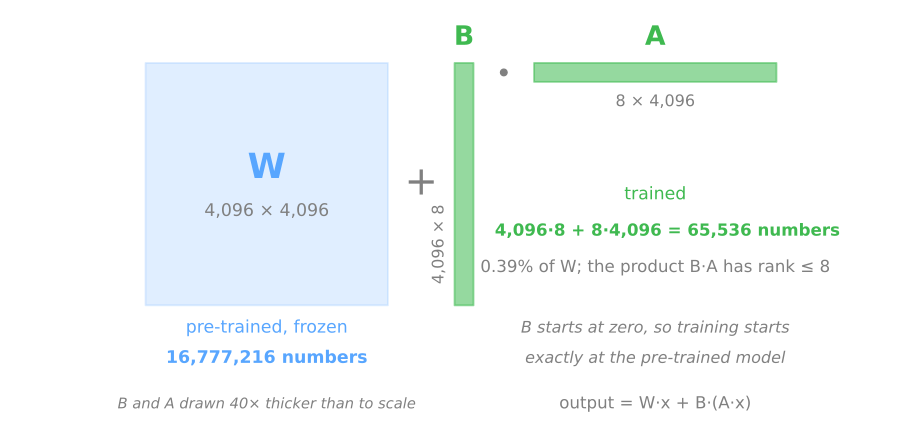
\(B\): \(4096 \times 8\); \(A\): \(8 \times 4096\). Together \(2 \times 4096 \times 8 = 65{,}536\) numbers, against 16,777,216 in \(W\): 0.39%.
Foundation models
- Transformers, self-supervised pre-training (predict masked or next tokens: the labels are free), billions of parameters.
- One very large model adapted to many tasks (Bommasani et al., 2021): GPT, Claude, Gemini, Llama for text; CLIP for vision and language; Whisper for speech.
- Why scale? Test loss falls as a smooth power law in parameters, data and compute (Kaplan et al., 2020).
With LLMs, adaptation gets lighter still
| adaptation | labeled data needed | what happens |
|---|---|---|
| zero-shot | none | describe the task in the prompt |
| few-shot / in-context | a handful | examples in the prompt; no weights change |
| fine-tuning (full / LoRA) | hundreds+ | update the weights, or a low-rank slice |
| RAG | none (needs documents) | retrieve passages by nearest-neighbor search over embeddings, put them in the context |
fit(), and you still need a labeled test set to know whether it works.The classical toolbox, inside the LLM stack
- The output layer is a softmax regression over the vocabulary; training is mini-batch gradient descent with weight decay (an L2 penalty) on cross-entropy.
- RAG systems are k-NN over embeddings; a vector database is an approximate nearest-neighbor engine.
- The reward model of RLHF is a logistic regression on pairs of answers.
- Evaluating an LLM system is precision/recall thinking plus honest held-out design; leaked test questions are the field's current leakage problem.
- BERTopic already composed foundation-model embeddings with UMAP, HDBSCAN and TF-IDF.
Where classical ML still wins
| situation | why classical wins |
|---|---|
| tabular data | gradient boosting still leads on medium-sized tables (Grinsztajn et al., 2022); LLMs are poor at tables of numbers |
| latency, cost, scale | a logistic regression scores a row in microseconds |
| regulated decisions | odds ratios and SHAP values (SHapley Additive exPlanations) can be shown to an auditor; a prompt cannot |
| small, structured problems | 2,000 rows need bias–variance control, not a trillion parameters |
| determinism | fixed model + fixed input = fixed output; LLMs sample |
One challenger on small tables: TabPFN, a transformer pre-trained on synthetic tables that predicts in one forward pass (advanced approach).
Routing: what to use when
| the request | route |
|---|---|
| free text, images or sound, few labels | foundation model: a prompt first; with a few hundred labels, embeddings + a classical head; fine-tune (LoRA) if neither is enough |
| the answer must come from your documents | RAG: a k-NN over their embeddings feeds the prompt |
| a table of numbers and categories | classical stack: gradient boosting by default; logistic regression to audit or to score in microseconds |
| both kinds of input | both: the foundation model turns text into columns, the classical model decides |
Summary
- Every technique has a place on the map; most of the frontier builds on chips this course taught.
- Transfer learning: a frozen model as a feature extractor, or fine-tuned (LoRA trains a thin slice).
- Foundation models: self-supervised pre-training at scale; adapted by a prompt, a few examples, retrieved passages or fine-tuning.
- Inside the LLM stack: softmax regression, gradient descent, k-NN retrieval, a logistic reward model, leakage.
- Route: language to foundation models, tables to the classical stack, real systems to both.
Route the problem, steps 1 to 4
- No notebook: copy the code of each step from the lesson page into a new Colab notebook, in order. Steps 1 and 4 need no code.
- Step 1: find your course on the map · step 2: the retrieval half of RAG is a k-NN · step 3: the reward model is a logistic regression · step 4: route six requests.
- At every step, answer the Predict before running or opening the solution.
- Simulations: the same question, in other words (step 2) and voters who like long answers (step 3).
Pace: step 1 in 5 min; step 2 and its simulation in 10 min; step 3 and its simulation in 10 min; step 4 in 5 min.