Examples
These examples demonstrate how to model different search problems with AI Gym.
Vacuum world
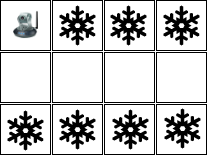
VacuumWorldGeneric.py receives a text file describing dirty rooms and the
robot's initial position. In the map, 0 means clean and 1 means dirty.
Run the example with the configuration file, row, and column:
The available actions move left, right, up, or down, or clean the current room. A valid solution reaches a state in which every room is clean.
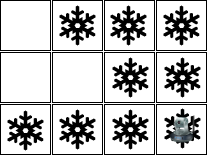
Another configuration can start the robot on row 2, column 3:
U2 bridge problem
The four members of U2 must cross a bridge in 17 minutes. It is night, they have one flashlight, and no more than two people can cross together. Bono, Edge, Adam, and Larry take 1, 2, 5, and 10 minutes respectively. A pair moves at the slower person's speed.
The objective is to move everyone and the flashlight to the other side with the lowest total cost.
8 Puzzle
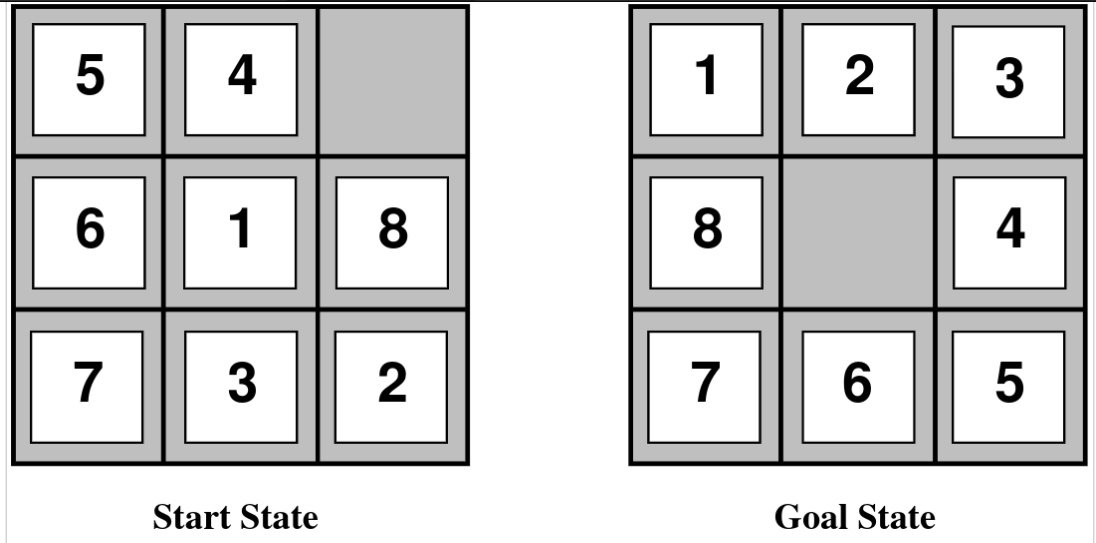
The 8 Puzzle example uses A* to arrange numbered tiles into the target state.
Noughts & Crosses
The Noughts & Crosses example models a complete 3×3 tic-tac-toe game for
MinMax. X is represented by 1 and maximizes utility; O is represented by
-1 and minimizes it; empty squares use 0.
Each state stores an immutable board and the next player. successors()
creates one state for every empty square. cost() returns a large terminal
utility for a win and a line-based estimate at the depth limit.
Run the example from the project root:
To display the decision tree, change the final call to play(trace=True).
MinMax displays two levels by default while preserving the complete selected
path. Increase trace_max_depth only for small game trees.