A question that sounds simple
- Nobody labels the documents, nobody lists the themes: unsupervised, the text-world sibling of clustering.
- Uses: a year of reviews or support tickets, a news archive, social media, a scientific literature.
LDA
a probabilistic story of how words are written
NMF
factorizes the TF-IDF matrix
BERTopic
sentence embeddings + UMAP + HDBSCAN + a variant of TF-IDF
Two corpora: 11 hand-written sentences, and 2,155 real posts from four forums (the forum is hidden from the models, to check them).
The path of this lesson
- What is a topic?words that go together, or documents that go together
- LDALatent Dirichlet Allocation: a story of how words get written
- NMFnon-negative matrix factorization: a document as a sum of parts
- BERTopicembed, reduce, cluster, describe
- Compare and choosethe three side by side; the pitfalls
What is a topic? Two answers
a distribution over words
"Sports" gives high probability to team, game, goal, almost none to oven. A document is a mixture: 80% sports, 20% space.
LDA, and NMF with non-negative weights
a cluster of documents
Each document belongs to one topic, or to none; the topic's words are computed afterwards, to describe the cluster.
BERTopic
The hand-made corpus, as counts
| doc | team | game | goal | rocket | launch | moon | bread | bake |
|---|---|---|---|---|---|---|---|---|
| 0 | 1 | 1 | 1 | 0 | 0 | 0 | 0 | 0 |
| 3 | 0 | 0 | 0 | 1 | 1 | 0 | 0 | 0 |
| 6 | 0 | 0 | 0 | 0 | 0 | 0 | 1 | 1 |
| 9 | 1 | 1 | 0 | 1 | 1 | 0 | 0 | 0 |
| 10 | 0 | 0 | 0 | 0 | 0 | 1 | 1 | 0 |
11 sentences, 53 words kept, a vocabulary of 33 (English stop words removed).
Three themes: sports, space, cooking; the last two sentences mix them.
LDA: a story of how the words got there
Latent Dirichlet Allocation (Blei, Ng & Jordan, 2003):
- each topic \(k\) is a distribution \(\varphi_k\) over the vocabulary;
- each document \(d\) has its own mixture \(\theta_d\), e.g. \((0.8, 0.2)\);
- for every word slot: draw a topic \(z\) from \(\theta_d\), then a word from \(\varphi_z\).
Not a claim that people write this way. Word order plays no part: bag-of-words counts are enough.
The story by hand
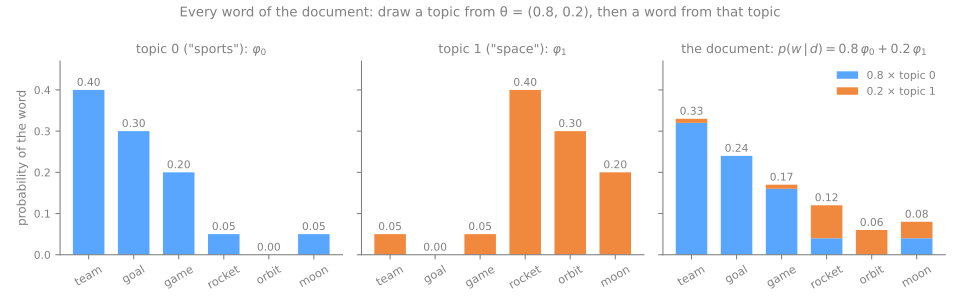
A document 80% sports, 20% space:
\(p(\textit{team}) = 0.8 \times 0.40 + 0.2 \times 0.05 = 0.33\)
\(p(\textit{rocket}) = 0.8 \times 0.05 + 0.2 \times 0.40 = 0.12\)
Following the story, 4 of 12 slots drew the space topic, and they are exactly where moon, orbit, rocket, orbit appear.
The Dirichlet prior: how mixed is a document?
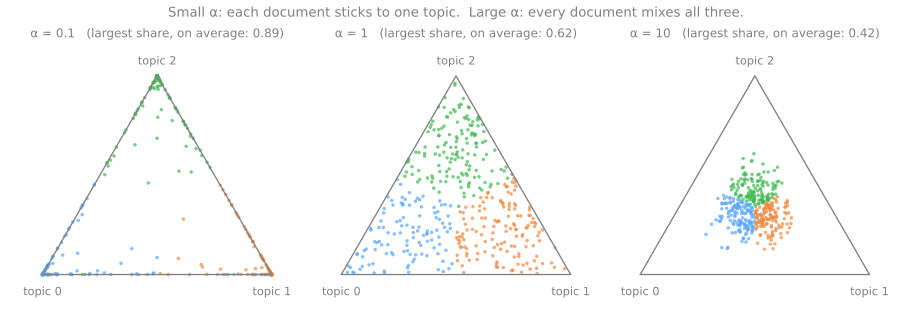
| \(\alpha\) | largest share |
|---|---|
| 0.1 | 0.89 |
| 1 | 0.62 |
| 10 | 0.42 |
In scikit-learn: doc_topic_prior and topic_word_prior, both \(1/k\) by default: few topics per document, few words per topic.
Simulator: write a document the LDA way
Predict. With \(\alpha = 0.1\), will the documents you draw come out in one color or in all three?
Fitting LDA: running the story backwards
- Generate a corpus with the story itself (300 documents, 30 words each), so the true topics are known.
- LDA recovers the true weights (0.35, 0.30, 0.25 on each topic's own words) within 0.01.
- The estimated mixtures correlate 0.97 with the true ones.
And on the 53 hand-written words?
- Seed 0: bread fresh game oven · team goal game orbit · rocket launch bread delayed: the themes mixed.
- Each document still goes confidently (0.86 to 0.88) to one topic.
- Over 20 seeds, only 1 separates the nine single-theme sentences cleanly.
LDA on 2,155 real posts
Four forums of 20 Newsgroups (graphics, hockey, space, religion); 5,725 words of 3+ letters in at least 5 posts and at most half of them.
| jpeg don pts like think play period gif |
| god space people think just jesus time like |
| team game hockey season games nhl play year |
| image edu data graphics space available software program |
NMF: \(X \approx WH\), with nothing negative
\[ X_{\,n \times V} \;\approx\; W_{\,n \times k}\; H_{\,k \times V}, \qquad W \ge 0,\; H \ge 0 \]rows of \(H\)
the topics: a weight for every word
rows of \(W\)
how much of each topic a document contains
Non-negative matrix factorization (Lee & Seung, 1999): the same shape as PCA, plus the constraint that every entry is \(\ge 0\). Here \(X\) is TF-IDF.
NMF on the 11 sentences
Topics: launch rocket satellite orbit · bread oven bake fresh · team game goal won
Clean split, where LDA failed 19 times out of 20.
init='nndsvda' starts from an SVD, not a random point: one reason the result is stable.
| sentence | space | cooking | sports |
|---|---|---|---|
| 0 (sports) | 0.00 | 0.00 | 0.71 |
| 3 (space) | 0.62 | 0.00 | 0.00 |
| 9 team watched the rocket launch… | 0.29 | 0.00 | 0.45 |
| 10 astronauts ate fresh bread… | 0.10 | 0.41 | 0.00 |
Why non-negative? A comparison with SVD
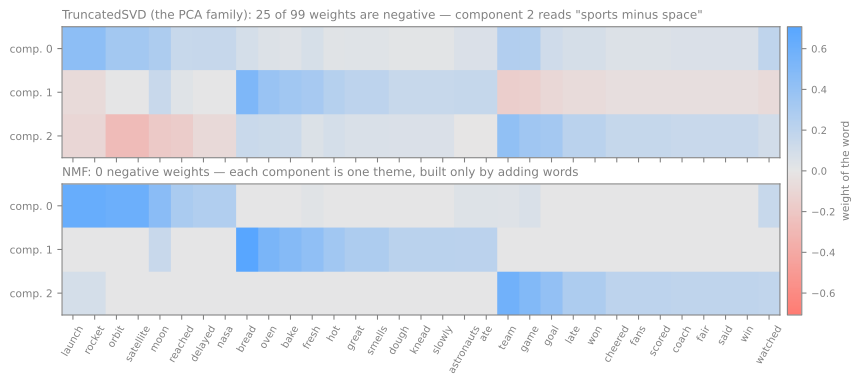
Simulator: NMF parts versus SVD directions
Predict. From random weights, press step: will the NMF rows end up as whole themes or as contrasts like the SVD's? Will its error reach the SVD's?
NMF on the posts
| graphics thanks files image program file know windows |
| god jesus people believe christ faith bible christians |
| game team hockey players play games season nhl |
| space nasa launch shuttle moon orbit lunar earth |
LDA
NMF
One run on one corpus: the lab finds a corpus where the order is reversed.
How many topics, and are they any good?
No labels to cross-validate against: the score must come from the documents.
perplexity
how surprised LDA is by held-out posts; lower is better; only for probabilistic models
coherence (NPMI)
do the top words co-occur in documents?
By hand: of 2,155 posts, 304 contain god, 159 jesus, 101 both; independent would be 1.04%, observed 4.69%: NPMI = 0.492.
Choosing \(k\)
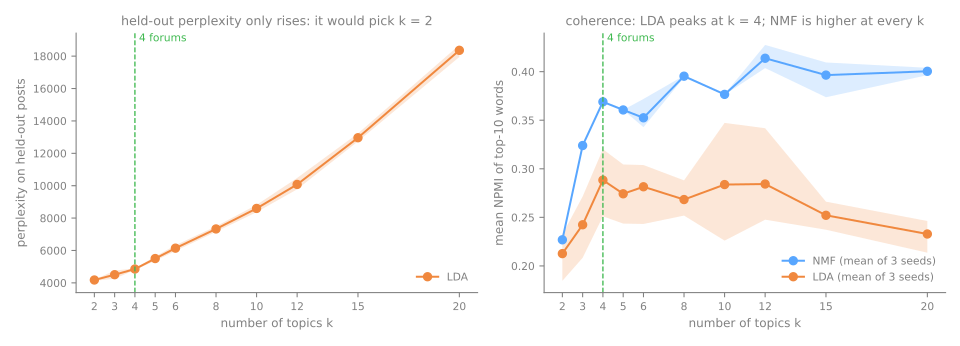
At \(k = 4\): LDA coherence 0.224, diversity 0.85; NMF 0.369 and 1.00.
Perplexity only rises: read literally, it recommends \(k = 2\); and it does not track what people find interpretable.
Short documents: where word counts run out
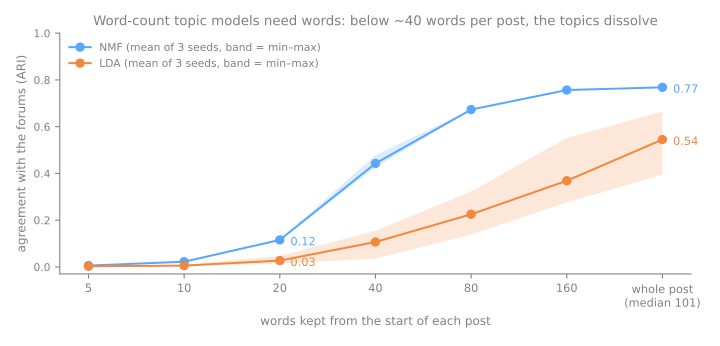
First 20 words of each post: NMF 0.12, LDA 0.03.
Meaning as distance
TF-IDF cosine
embedding cosine
On the 20-word posts, plain k-means on the embeddings reaches ARI 0.582, five times NMF's.
BERTopic: four steps, each a lesson you know
Stage 1 — embed
Each post → 384 numbers with all-MiniLM-L6-v2 (small, English, fast on a CPU).
TF-IDF
embeddings
Stage 2 — reduce with UMAP
- In 384 dimensions distances concentrate: density-based clustering suffers.
- UMAP to 5 dimensions, not 2: the goal is to cluster, not to draw.
min_dist=0.0packs similar points tightly, which a density clusterer wants.
random_state.Stage 3 — cluster with HDBSCAN
clusters
min_cluster_size=10 and the densityoutliers (−1)
pure
Hockey (516) and religion (554) are one big cluster each; graphics and space break into many small ones (file formats, graphics cards, the Moon…).
Simulator: min_cluster_size, one value at a time
Predict. Raise min_cluster_size from 2 to 40: will the number of topics fall smoothly?
Stage 4 — describe each cluster with c-TF-IDF
Join the documents of a cluster into one pseudo-document; then a class-based TF-IDF:
\[ \text{c-TF-IDF}(t, c) = \frac{n_{t,c}}{\sum_{t'} n_{t',c}} \times \log\!\Big(1 + \frac{A}{f_t}\Big) \]By hand, three clusters of the hand-made sentences: 16, 13 and 14 words, \(A = 14\).
team (3×, all sports)
\(\tfrac{3}{16} \times \log(1 + 14/3) = 0.325\)
game (2×)
\(\tfrac{2}{16} \times \log 8 = 0.260\)
BERTopic's own transformer gives exactly the same matrix.
The clusters of the posts, named
| cluster | posts | top words |
|---|---|---|
| −1 | 431 | space jpeg launch image (the outliers) |
| 1 | 567 | god jesus people church |
| 0 | 520 | team game hockey play |
| 15 | 66 | image graphics package processing |
| 9 | 55 | card mode vesa vga |
| 23 | 52 | moon lunar prize money |
The class BERTopic chains the same four steps: same partition (ARI 1.0), same top words, only renumbered by size.
Stage 5 — tune the words, not the clusters
| topic 2, named by… | top words |
|---|---|
| default vectorizer | image and for of to it or the graphics with |
| stop words removed | image graphics package processing software data analysis … |
| KeyBERTInspired | graphical graphics rtrace plots tools interactive plotting … |
update_topics changes them and the post-to-topic assignments stay identical.LDA vs NMF vs BERTopic, measured
Same 2,155 posts, 24 topics for all three, two seeds each. Predict first: whose topics are purest?
| model | seed | topics | outliers | coherence | diversity | homogeneity |
|---|---|---|---|---|---|---|
| LDA | 42 | 24 | 0% | 0.265 | 0.72 | 0.526 |
| NMF | 42 | 24 | 0% | 0.391 | 0.92 | 0.646 |
| BERTopic | 42 | 24 | 20% | 0.251 | 0.88 | 0.927 |
| LDA | 43 | 24 | 0% | 0.276 | 0.70 | 0.574 |
| NMF | 43 | 24 | 0% | 0.407 | 0.91 | 0.644 |
| BERTopic | 43 | 16 | 10% | 0.295 | 0.82 | 0.662 |
Reading the table
- Homogeneity: BERTopic 0.927, but on the 80% of posts it kept; with seed 43 it finds 16 broader topics and falls to 0.662.
- Coherence and diversity favor NMF: NPMI rewards co-occurring words, which NMF reconstructs; BERTopic picks distinctive words.
- Stability between seeds (ARI): LDA 0.164, NMF 0.736, BERTopic 0.324, with even the number of topics changing.
The overall comparison
| LDA | NMF | BERTopic | |
|---|---|---|---|
| a topic is | a distribution over words | a non-negative row of \(H\) | a cluster, named by c-TF-IDF |
| number of topics | fixed in advance | fixed in advance | found by HDBSCAN |
| short documents | weak | weak | strong |
| outliers | none | none | explicit (−1) |
| seed-dependence | strong | weaker (SVD start) | yes, even the number of topics |
| cost | cheap, CPU | cheapest, CPU | embedding model; a GPU helps |
Pitfalls: stop words and outliers
stop words
Without a list, topics are named by the, of, to. A list in the wrong language does not help: topic 6 here is van, het, een, from posts in Dutch.
too many outliers
reduce_outliers reassigns all 431. Homogeneity on all posts: 0.822 (c-TF-IDF) or 0.882 (embeddings), down from 0.927.
Pitfall: granularity is a cliff, not a dial
min_cluster_size from 10 to 15: a few topics fewer, or a lot?| min_cluster_size | topics | outliers |
|---|---|---|
| 5 | 96 | 28% |
| 10 | 24 | 20% |
| 15 | 5 | 0% |
| 25 | 3 | 0% |
Scan a few values and read the topics; to merge topics without re-clustering, reduce_topics.
Pitfall: reproducibility
Add to the embeddings a noise of about one millionth (the size of CPU-vs-GPU differences), keep every seed:
| noise, seed 0 | 24 topics, ARI with the original 0.908 |
| noise, seed 1 | 24 topics, ARI 0.910 |
| noise, seed 2 | 3 topics, ARI 0.514 |
Summary
- A topic is a distribution over words (LDA, NMF) or a cluster of documents (BERTopic).
- LDA: a generative story; needs many documents with enough words.
- NMF: additive parts of the TF-IDF matrix; stable, cheap, coherent.
- Choose \(k\) with coherence and by reading the topics; perplexity misleads.
- BERTopic: embed → UMAP → HDBSCAN → c-TF-IDF; strong on short texts, explicit outliers, fragile to seeds and to
min_cluster_size.
Topics in five forums, three ways
- Five other forums of 20 Newsgroups: 2,613 posts, between 495 and 551 per forum.
- Steps 2–3: LDA and NMF. Steps 4–7: BERTopic step by step, then in one call. Steps 8–10: inspect the topics, compare them with the forums, deal with the outliers.
- Download the lab notebook and open it in Jupyter or Colab; in Colab run
!pip install bertopicfirst. - Run the blocks in order, in one session; most of the time is step 4.